
Channel: Veritasium
How An Infinite Hotel Ran Out Of Room
The Signal
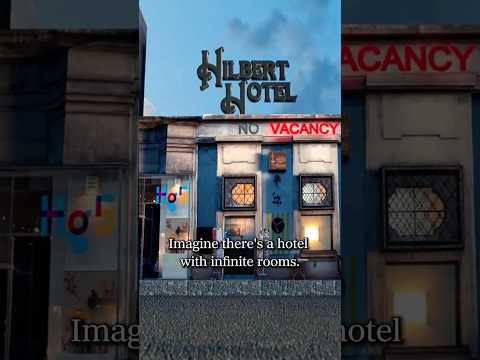
This video explains the Hilbert Hotel, a thought experiment describing an infinite hotel where every room is occupied, to show how mathematicians manage countable infinity. The creator argues that even a full, infinite hotel can accommodate more guests—ranging from one person to infinite buses—by utilizing various reindexing strategies. The core claim is that these infinite sets can always be mapped to, and fit within, the same set of infinite rooms.
The Case
- To house one new guest, the hotel shifts each existing occupant from room n to n+1, which leaves room 1 empty for the arrival.
- A bus holding 100 passengers is accommodated by shifting every current guest down by 100 rooms, creating 100 consecutive vacant rooms.
- An infinite number of passengers on a single bus are seated by moving current guests to even-numbered rooms, which leaves an infinite supply of odd-numbered rooms available.
- To fit infinitely many buses, each passenger is assigned a unique identifier based on their bus and seat number, creating an infinite grid of guests.
- The narrator claims a zigzag path—drawing a line across the grid so it passes over each passenger exactly once—allows these infinite arrivals to be ordered into a single stream and assigned to rooms.
- The final argument assumes that straightening this zigzagged path into one continuous line is a complete mathematical solution, though the video provides this as a visual heuristic rather than a formal proof.
The 1 Minute Signal Take
The explanation elegantly maps increasing levels of complexity, but the final step relies on a metaphor that assumes the validity of its own enumeration without proving it. Watch it if you want an intuitive, visual grasp of countable infinity, but skip it if you are looking for formal mathematical rigor since the most complex justifications are presented as intuitive leaps.
Time saved:
Channel: Veritasium