
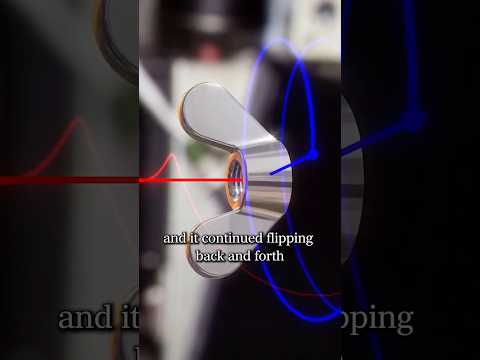
- The Dzhanibekov effect describes the unstable rotation of an object around its intermediate axis of inertia.
- Vladimir Dzhanibekov first observed this while repairing the Salyut 7 space station in 1985.
- The Soviet Union classified the discovery for ten years due to the counterintuitive nature of the rotation.
- The 1991 'Twisting Tennis Racket' paper confirmed the physics behind why objects flip in mid-air.
Channel: Veritasium
The Bizarre Behaviour Of Rotating Bodies
This video introduces the Dzhanibekov effect, a counterintuitive physics phenomenon where a rotating object periodically flips its orientation along its intermediate axis.
Key Takeaways
- The Dzhanibekov effect, also known as the intermediate axis theorem, causes rotating objects to spontaneously flip orientation periodically in weightless environments.
- The phenomenon was famously discovered by cosmonaut Vladimir Dzhanibekov while working on the Salyut 7 space station in 1985 and was initially kept classified for a decade.
Talking Points
Analysis
Significance
The Dzhanibekov effect is a profound illustration of classical mechanics that challenges our intuition about stable and unstable rotation. While it may seem like a parlor trick, understanding these dynamics is crucial for aerospace engineering, satellite stability, and the design of space-based equipment.
Target Audience
Engineers, physicists, and space exploration enthusiasts should care about this because it represents how subtle physical laws can deviate from expected outcomes in microgravity environments, potentially impacting sensitive instrumentation.
Non-Obvious Takeaway
Because of its counterintuitive nature, the phenomenon was actually feared to be a potential sign of structural instability or anomalous forces by those who first documented it, explaining the decade-long classification of the discovery rather than treating it merely as an academic oddity.
Time saved:
Channel: Veritasium