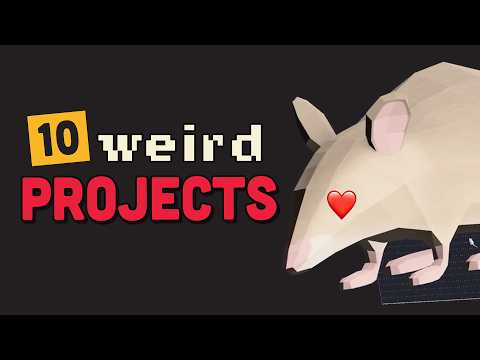
10 weird OSS projects you need right now...

Video thumbnail: 10 weird OSS projects you need right now...
May 26, 20267m 3s video lengthFireship

The Signal

This edition of "The Code Report" showcases ten unconventional software projects that contrast with the host's perception of an AI-saturated software industry. The central tension pits human-built, whimsical experimentation against the rising tide of AI-generated "slop" on developer feeds, though the technical capabilities of these highlighted tools remain largely anecdotal and unverified claims.

The Case

  • Ratty, a terminal emulator by Orin Paraxes, uses the Bevy game engine to render a 3D environment and spinning cursor, at the cost of 300 MB of RAM.0:53
  • Terminal Phone enables push-to-talk voice and text communication directly from and within the shell by routing traffic over Tor, using onion addresses as identities instead of phone numbers.1:39
  • CUDA Oxide, a project quietly released by Nvidia on GitHub, claims to allow developers to compile Rust GPU kernels directly to PTX without needing C++ or foreign function interfaces.2:58
  • Honker, a Rust-based SQLite extension by Russell Romney, embeds message queues, durable pubsub, and cron job scheduling directly into the database file, aiming to move functionality out of complex infra like Kubernetes.5:28
  • Exipedia renders a Simple Wikipedia dataset as an infinite, TikTok-style feed, with the entire algorithm running locally inside the browser after a 40 MB background download.4:37
  • Hyper Agent, the video's sponsor, claims to provide a cloud sandbox that gives AI agents persistent access to a browser, shell, and file system, rather than just simple tool calls.6:17

The 1 Minute Signal Take

The video succeeds as a showcase of aesthetic and architectural curiosity, but its broader claims about market sentiment and the "importance" of these tools are purely subjective salesmanship. Skip this video if you are looking for vetted technical reviews, but watch it if you want an unfiltered tour of hobbyist extremes that challenge standard infrastructure assumptions.

Pro Analysis

Strategic Significance

This showcase represents a cultural pivot within developer circles: a reaction against 'AI slop' and an attempt to reclaim the terminal as a site of creative, artisanal expression rather than just a place to pipe data into automation bots. It serves as a reminder that architectural elegance can often be found in simplification rather than scaling.

Who Should Care

  • System Architects: Those feeling the weight of over-engineered infrastructure will find tools like Honker highly resonant.
  • Rust Developers: The release of CUDA Oxide signals a shift in how low-level GPU programming could be modernized.
  • Privacy Advocates: Projects like terminal phone demonstrate how existing standards (like Tor/onion) can be repurposed for entirely new types of local, private tooling.

Contrarian Takeaway

We often measure software success by its adoption and scalability. However, the most vital projects in 2026—like an ad blocker that turns the web into a horror movie or a terminal with a 3D-rendered rat cursor—succeed precisely because they are 'unnecessary.' Their value lies not in market share, but in maintaining a vibrant, human-centric software ecosystem that exists independently of current industry trends.

Time saved:4m 34s

Share this

Tags

Written by: 1 Minute Signal Editorial Team