
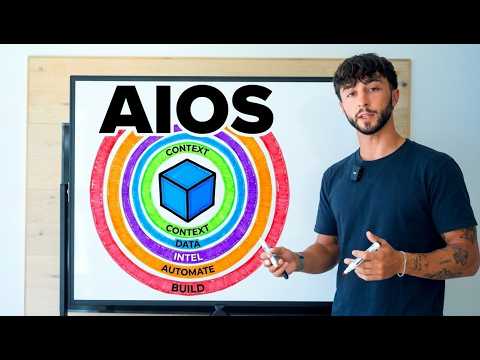
- AIOS is a strategic way to run a business by wrapping it in an intelligent layer rather than changing the business model itself.
- The 'operator trap' is the primary barrier to growth, where founders spend excessive time inside the business rather than working on it.
- Claude code serves as a powerful, context-aware environment rather than a simple conversational chatbot.
- The 'daily brief' is a critical component that uses integrated data to provide founders with a synthesized account of business performance every morning.
- Implementation starts with a task audit, followed by layered integrations of context, data, and intelligence tools.
- Key performance indicators for an AIOS include away-from-desk autonomy, task automation percentage, and revenue per employee.
- The rapid rise in AI capabilities suggests a 'bloodbath' for inefficient small businesses that fail to adapt their operations.
- A high-functioning AIOS enables non-technical founders to automate tasks that previously required expensive specialized labor or large teams.
Channel: Liam Ottley
What Is an AI Operating System? (And Why Every Business Will Need One)
Key Takeaways
- An AI Operating System (AIOS) is a business methodology, not a standalone model, acting as an intelligent, contextual layer around existing business operations.
- By integrating context, data, and communication records, founders can achieve significant automation and augmentation, shifting focus from task-heavy maintenance to high-growth strategic initiatives.
- Establishing a dedicated AI-native workspace allows for superior handling of complex, multi-functional business workflows compared to static, web-based chatbots.
Talking Points
Analysis
Strategic Importance
The premise of an 'AI Operating System' is highly relevant as we transition from AI as a 'chatbot app' to AI as a 'Business Core.' For organizational leaders, this marks a shift from hiring for 'execution' to hiring for 'architecting' automated systems.
The Human Impact
People working directly with AI must pivot from being 'prompt engineers' to becoming 'system orchestrators' who understand how to connect APIs, document workflows, and manage AI context.
Contrarian/Non-Obvious Takeaway
The most potent insight is that this methodology acts as an equalizer that renders large headcount unnecessary. A lean team with a well-configured AIOS can feasibly outperform a legacy business of 50+ people.
Missing Elements & Next Steps
The content focuses heavily on the 'why' and 'what' but remains thin on the security/privacy concerns regarding piping all internal slack and meeting data into a local AI workspace. Potential next steps include auditing existing workflows for high-value automation risks and determining the 'threshold of trust' for AI-automated outbound communication.
Time saved:
Channel: Liam Ottley