
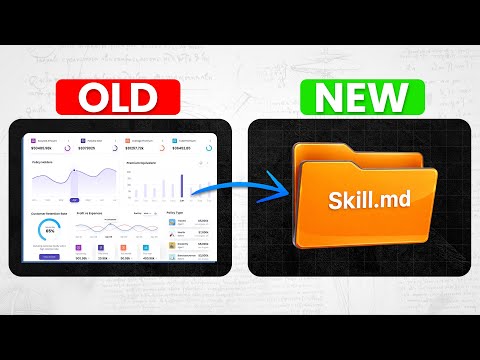
- Traditional SaaS businesses require vast resources for interfaces, infrastructure, and marketing.
- The new 'skills-based' approach allows one person to build and market software in a single weekend.
- Risks in the platform-based agent economy include high volatility and frequent architectural shifts.
- Five business models exist: Prompt Templates, Utilities, API Integrations, Backend SaaS, and Data-Backed Intelligence.
- The most defensible businesses are built on proprietary data, not just prompt engineering.
- Security in AI-agent-based businesses is the developer's responsibility; public hosting requires careful patching.
- The primary barrier to AI in corporate settings is not technological, but human adoption and cultural resistance.
- Agency services involving AI auditing and staff training are highly robust, proven alternatives to product-based AI ventures.
- Futureproofing a career involves developing skills in change management and consulting rather than just coding specific AI tools.
Channel: Liam Ottley
The Easiest Software Business to Start in 2026
Key Takeaways
- The emergence of agentic AI platforms like Open Interpreter allows non-technical users to build micro-SaaS tools faster than ever before.
- There are five distinct categories of AI-integrated businesses, ranging from simple prompt-based templates to complex proprietary data-backed services.
- Relying solely on new, rapidly evolving platforms carries high risk, as foundational infrastructure often changes, potentially breaking unproven business models.
- A proven, sustainable approach involves building an AI agency focused on human-centric problems like organizational adoption, change management, and consulting.
Talking Points
Analysis
This video is a masterclass in strategic prioritization. Molley correctly identifies that while building a software tool feels like the ultimate 'leverage' move, it is often a trap for non-technical entrepreneurs. He contrasts the high-risk/high-reward 'sand' (platform-dependent micro-apps) with the 'rock' (service-based agency work).
Why it matters:
Most tech influencers push 'build an app' narratives. Molley’s focus on the human element of AI adoption is the real strategic insight. Organizations do not struggle with the technology; they struggle with integration, process change, and staff training. By shifting from 'product provider' to 'strategic partner,' an agency creates a sticky, long-term business model that survives market volatility.
Contrarian Takeaway:
Building a 'SaaS' is actually a disadvantage for most beginners. The maintenance burden and churn associated with micro-SaaS are often worse than high-ticket professional services work. You should only build a product once the agency work makes the need for that product blindingly obvious.
Time saved:
Channel: Liam Ottley