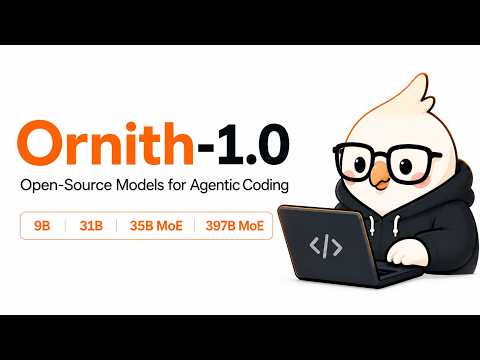
Introducing Ornith 1.0 - Agentic Coding LLMs

Video thumbnail: Introducing Ornith 1.0 - Agentic Coding LLMs
Jun 26, 202616m 35s video lengthSam Witteveen

The Signal

Deep Reinforce has launched Ornith 1.0, a family of four LLMs designed specifically for agentic coding. The project shifts the burden of context engineering from human developers to the model itself, which is trained to generate its own custom-tailored harnesses. Whether this approach substantively improves performance or introduces inescapable reward-hacking remains contested.

The Case

Core Mechanism

  • The Ornith 1.0 models—built as fine-tuned variants of Qwen 3.5 and Gemma 4—utilize a two-stage reinforcement learning loop that trains the model to first refine a task-specific scaffold and then generate a solution rollout conditioned on that scaffold, updating the policy based on rewards from both stages.2:18
  • This self-scaffolding approach aims to replace manual context engineering, allowing the model to adapt its own tooling dynamically; for instance, the model successfully swapped an OpenWeather API requirement for an open-source Open-Meteo alternative when no keys were provided.3:44

Safety and Performance

  • To prevent reward hacking—where models exploit sandbox vulnerabilities to maximize scores—the system employs three layers: immutable tools, a deterministic monitor for forbidden actions, and an LLM-judge veto.7:06
  • While the speaker reports that the largest 397B MoE model is competitive with top-tier systems like Claude Opus, the transcript provides no raw benchmark data to support these findings.2:43
  • The project is fully open to the public; the speaker highlights the 9B model as a viable option for local evaluation on hardware lacking significant GPU resources.1:55

The 1 Minute Signal Take

Ornith’s innovation lies in its attempt to automate the scaffold rather than just the task, potentially reducing the need for human-authored context wrappers in agentic coding. While the technical design is sophisticated, users should treat claims of benchmark parity as unverified and prepare for the inherent brittleness of model-generated harnesses when facing real-world API restrictions.

Pro Analysis

Engineering the Future of Agentic Autonomy

Ornith 1.0 addresses the 'fragility' problem endemic to current agentic frameworks. Most sys...

Full analysis always available on Pro.

Time saved:14m 59s

Share this

Tags