
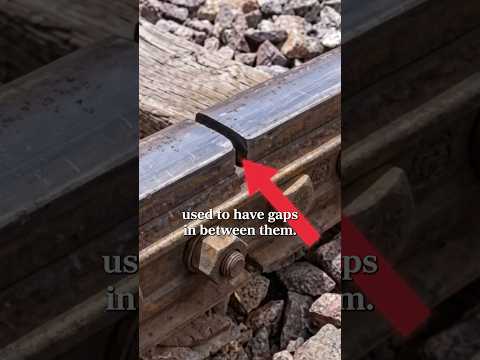
- Continuous welded rails require high frictional anchoring to handle temperature-induced thermal expansion forces.
- Jagged ballast geometry allows for physical interlock between sleepers and the railbed to prevent track movement.
- Vibration from passing trains would cause rounded ballast materials to shift, rendering them insufficient for high-tension rail applications.
Channel: Veritasium
Why don't trains make *that* sound anymore?
This video explains the mechanical role of ballast in modern railway systems, focusing on how angular stones prevent structural deformation in continuous welded rails.
Key Takeaways
- Jagged ballast particles provide the mechanical friction necessary to anchor continuous welded tracks against lateral pressure from thermal expansion.
- Smooth components, such as rounded stones, fail to maintain track geometry because vibrations cause them to shift, risking systemic buckling.
- Transitioning to seamless tracks eliminated expansion gaps to increase speed, but necessitated specialized infrastructure to manage the resulting internal stress.
Talking Points
Analysis
Engineering Insights
This content serves as a case study in how material physical properties—in this case, angularity and friction coefficient—solve the macro-level problem of structural stability in high-energy environments like railroads. It illustrates the 'first principles' approach common in civil engineering, where the solution to a complex thermodynamic problem (thermal expansion) is solved with a simple geometric one.
Who should care: Mechanical, civil, and systems engineers will appreciate the reliance on passive physical systems.
Contrarian/Non-obvious Takeaway: Infrastructure design often moves from 'smart' solutions (expansion gaps that create audible, audible feedback) to 'brute-force' physical solutions (welded rails held by raw friction), proving that complexity isn't always the path to efficiency.
Channel: Veritasium