
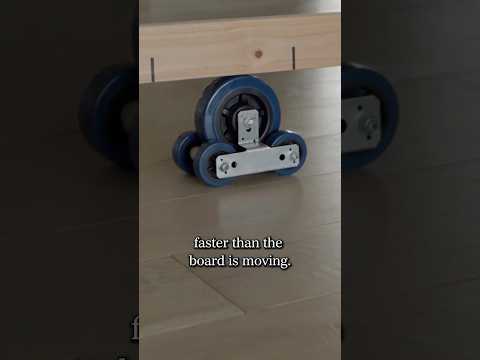
- Objects in contact with two differentially moving media can travel faster than the speed of the media itself.
- Gear configurations and wheel rotations are the primary drivers of this speed, rather than aerodynamics.
- The Blackbird downwind vehicle serves as the real-world application of this mechanical principle.
- These demonstration models are simple enough to be constructed by hobbyists at home.
Channel: Veritasium
Can something go faster than it’s pushed?
This video provides a simple physics demonstration using a model cart to explain how vehicles can travel faster than the wind while moving downwind without relying on aerodynamics.
Key Takeaways
Talking Points
Analysis
Importance of the Concept
This demonstration is strategically important for conceptualizing energy conversion in mechanical systems. It challenges the common intuition that wind-powered vehicles are limited by the speed of the wind, proving that energy can be extracted from the differential between two frames of reference (ground and air).
Target Audience
Engineers, physics students, and DIY hobbyists should be interested in this as it highlights how mechanical design can bypass conventional performance limits.
Contrarian Takeaway
Most people assume 'sailing' faster than the wind requires complex sail geometry or aerodynamics. This video proves that, fundamentally, the mechanism is a purely mechanical gear-train problem, rendering complex aerodynamic 'tricks' secondary or unnecessary for achieving faster-than-the-wind speeds.
Channel: Veritasium