
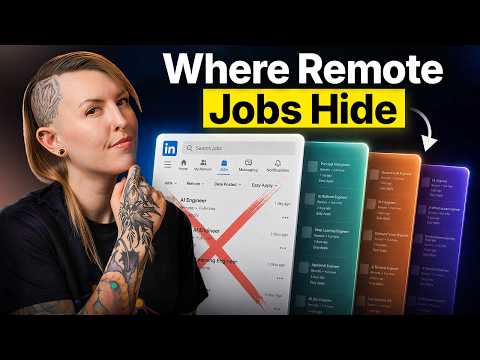
- Remote job availability is declining due to specific mandates rather than a general loss of interest in distributed work.
- LinkedIn is a poor indicator of the remote job market because its high costs favor large, office-centric firms over distributed startups.
- Proven, self-documented work is the primary indicator of remote competence for hiring managers.
- Asynchronous writing quality during the application serves as a critical, early-stage audition for remote roles.
Channel: Marina Wyss - AI & Machine Learning
Your LinkedIn Search Won't Find Remote Tech Jobs in 2026 (Here's What Will)
This presentation outlines strategies for identifying and securing remote positions in a tightening job market driven by return-to-office mandates at major tech companies. It provides actionable advice on where to search for distributed-first companies and how to prove one's value through technical artifacts.
Key Takeaways
- Large firms are aggressively pushing for office returns, causing a significant decline in indexed remote job postings.
- Small, distributed-first companies avoid expensive public boards, favoring niche platforms that favor remote work.
- Candidates succeed by showcasing verifiable work samples rather than relying on standard application materials.
- Clear, asynchronous communication serves as a proxy for physical presence in remote environments.
Talking Points
Analysis
Strategic Significance: - Understanding the structural shift in job boards is critical for navigating the current market. Passive ...
Full analysis available on Pro.
Time saved:
Channel: Marina Wyss - AI & Machine Learning