
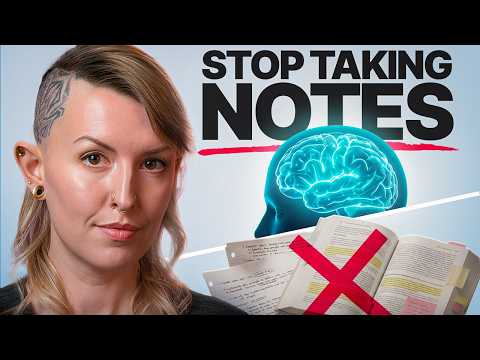
- Rereading material leads to a false sense of familiarity known as the fluency illusion.
- Active recall and testing require more mental effort because they force you to retrieve information rather than recognize it.
- Pretesting allows the brain to create gaps in knowledge that are better filled during formal study.
- The Ebbinghaus forgetting curve shows that most new information is lost within 48 hours without systematic review.
- Spaced repetition is more effective than binge-studying because it reinforces memory over time.
- Interleaved practice, or shuffling topics, beats blocked study by training the brain to identify which concept to apply when.
- The Feynman technique, explained by articulating concepts simply, is essential for uncovering true comprehension gaps.
- Combining walking with speaking creates a multi-sensory environment that improves cognitive encoding.
Channel: Marina Wyss - AI & Machine Learning
How I Actually Retain What I Study (The System That Replaced All My Notes)
This video examines scientifically-backed study habits that transcend traditional methods, focusing on how learners can retain complex technical knowledge, such as machine learning, through retrieval and spaced repetition.
Key Takeaways
- Shift from passive rereading to active recall, which forces your brain to retrieve information rather than simply recognizing it.
- Use pretesting to quiz yourself on unfamiliar topics before learning them to create cognitive gaps that the brain is primed to fill.
- Combat the forgetting curve by implementing spaced repetition, reviewing material at increasing intervals to ensure long-term retention.
- Leverage dual coding and embodied cognition by physically moving and explaining complex concepts out loud to engage multiple brain regions.
Talking Points
Analysis
Why This Matters In technical fields like AI and machine learning, the sheer volume of information can be overwhelming. This appro...
Full analysis available on Pro.
Time saved:
Channel: Marina Wyss - AI & Machine Learning