
- The magnetic field of the human heart is roughly a million times weaker than Earth's ambient magnetic field, rendering it extremely difficult to isolate at range.
- NV centers represent a paradigm shift in sensing, allowing room-temperature operation of quantum sensors that were previously restricted to shielded, cryogenic laboratory environments.
- Strategic misinformation remains a standard intelligence tactic to cloak the use of existing, sensitive surveillance technology under the guise of 'magical' or futuristic breakthroughs.
- Navigation through magnetic field mapping represents a far more viable and likely application of advanced diamond magnetometry than remote biometric tracking.
Back to Feed
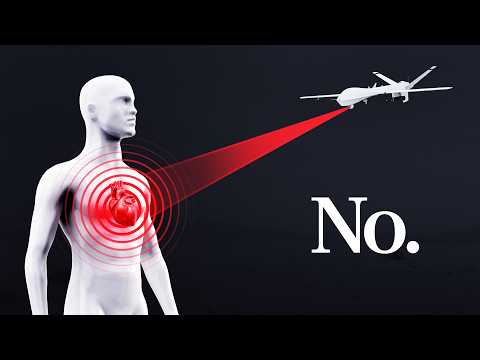
Can a quantum sensor detect your heartbeat from 60 km away?
This video investigates the technical feasibility of recent reports claiming the CIA used quantum diamond magnetometers to track a human heartbeat from kilometers away.
Key Takeaways
- Detecting human heartbeats from kilometers away is physically impossible due to the inverse-cube law of magnetic field suppression, which would require sensitivity levels 18 orders of magnitude beyond current technology.
- Synthetic diamonds with nitrogen-vacancy (NV) centers effectively function as room-temperature magnetometers by observing Zeeman splitting, but their operational range is limited to millimeter-scale proximity to the signal source.
- Intelligence agencies often utilize plausible deniability and deliberate misinformation campaigns, such as historical 'carrot' myths, to conceal the actual sensors or signals (like GPS beacons) employed in rescue operations.
Talking Points
Analysis
Why This Matters This analysis demystifies a piece of modern 'techno-mythology' that serves as a bridge between scientific progres...
Full analysis available on Pro.
Time saved:
Back to Feed