
Back to Feed
Animated Comedy Shortfilm Project with AI! | Full Breakdown
The Signal
Creating an AI-animated short film is currently a labor-intensive, multi-tool workflow rather than a one-shot generation process. The creator, who produced a three-minute sci-fi sitcom segment, argues that while AI video has finally become 'watchable' and capable of sustaining character consistency, the final output is entirely dependent on heavy manual post-production, audio replacement, and aggressive clip splicing to fix artifacts.
The Case
- Iterative editing is the project's load-bearing mechanic: the creator performed significant splicing and cutting to build a coherent, three-minute narrative out of dozens of short, flawed clips.
- SeaDance 2.0, the primary animation generator used, struggled with spatial complexity: in one scene, it hallucinated multiple versions of the same character, resulting in two or three aliens occupying the same UFO interior.
- Voice consistency remains a high-touch manual fix: the model occasionally generated voices resembling copyrighted characters, forcing the creator to output audio for every line and replace it using ElevenLabs, an AI voice-cloning service.
- Gemini Omni is effective for real-video editing and visual effects, such as outpainting textures or transforming existing footage, but the creator found it unsuitable for their stylized 2D animation needs.
- Production costs are deceptively high: while per-generation pricing is competitive on platforms like the sponsor Polo AI, achieving a three-minute result requires substantial upfront commitments to annual or 'ultra' plans to avoid credit exhaustion.
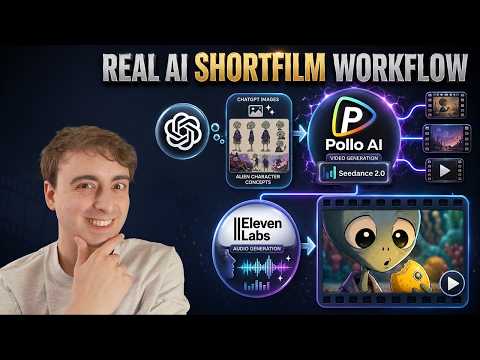
- The workflow is a disjointed multi-tool chain: the project relied on CodeX for scripting and prompts, GPT Image 2 for character sheets, SeaDance 2.0 for generation, and ElevenLabs for audio, rather than a single unified 'AI filmmaker' product.
The 1 Minute Signal Take
This video succeeds as a realistic baseline for what an individual can build today with current AI tools; it correctly identifies that labor cost is simply shifting from manual animation to manual curation. Skip it if you want high-level theory, but watch it if you need a granular look at why 'one-shot' video generation is currently a marketing myth.
Time saved:
Tags
Back to Feed