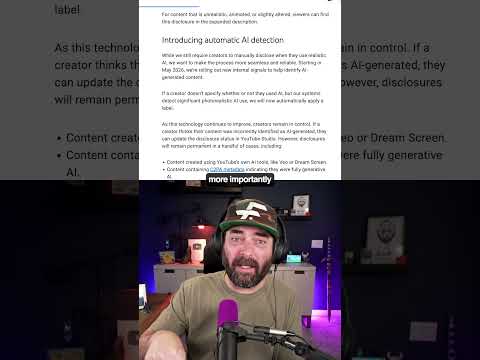
YouTube Is Cracking Down On AI Slop

Video thumbnail: YouTube Is Cracking Down On AI Slop
Jun 4, 202641s video lengthMatt Wolfe

The Signal

YouTube is shifting from a creator-led AI disclosure model to a proactive enforcement system. Starting in May, the platform will move disclosure requirements to a more prominent interface and introduce automated labeling that triggers if systems detect undisclosed but significant photorealistic AI use. This transition attempts to solve for low voluntary compliance while creating new uncertainties for creators who use AI only in segments of their work.

The Case

  • YouTube will now automatically apply an AI label to videos if a creator fails to disclose usage, triggered specifically by internal signals identifying significant photorealistic AI content.0:17
  • The current disclosure workflow, which relies on creators manually checking a box in the backend, is being replaced by a more visible, prominent disclosure position within the upload process.
  • The speaker claims that most creators currently ignore the disclosure box, though this assertion rests on personal impression rather than provided data or audited statistics.
  • The speaker’s own content—frequently featuring AI-generated intros followed by manually produced segments—remains a potential test case for the system’s sensitivity to partial or mixed media use.

The 1 Minute Signal Take

This update signals that YouTube is moving away from the honor system and toward objective, platform-level detection of synthetic media. Because the actual performance of these "internal signals" is unverified and the threshold for "significant" use is not defined, expect friction in mixed-format content. Skip the video; the summary covers the entire technical and policy shift.

Pro Analysis

Strategic Significance

YouTube is shifting from a trust-based model to a verifiable one. By automating the identification of "significant photorealistic AI," they are reducing the reputational and legal risks associated with misinformation spreading via deepfakes or synthetic media, while simultaneously tightening control over their ecosystem's metadata.

Who Should Care

Creators who use partial AI, such as AI-enhanced voiceovers or thumbnails, face the highest risk of misclassification. Furthermore, platform-watchers and trust-and-safety researchers should watch how YouTube defines the "significant" threshold, as it will set the industry standard for what constitutes "AI-labeled content."

Contrarian Takeaway

Automatic detection may inadvertently penalize hybrid creations more than fully automated spam. Large-scale AI content farms can easily game a system built on "internal signals," while individual creators are far more susceptible to erratic mislabeling of their creative hybrid works.

Share this

Tags

Written by: 1 Minute Signal Editorial Team