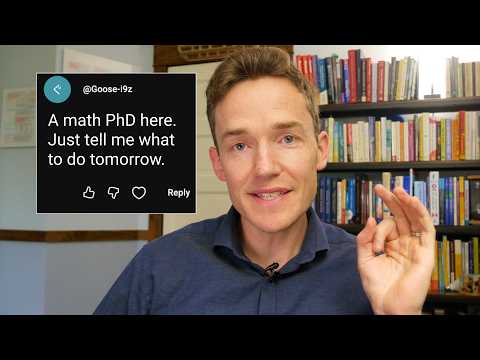
There's never been a better time to go into math

Video thumbnail: There's never been a better time to go into math
Oct 16, 202640m 44s video length3Blue1Brown

The Signal

AI's rapid ascent from basic arithmetic to research-grade theorem proving has triggered a crisis of purpose among mathematicians. While proof generation is being rapidly automated, the field's core value—theory-building, aesthetic joy, and teaching—remains resilient. Math is undergoing a shift where proofs become raw data, and human researchers must adapt by reorienting around deeper creative work.

The Case

The Shift in Mathematical Value

  • Proof production is no longer the ultimate goal; machines are proving theorems at a contest and research level, rendering proof a commodity or "raw data" rather than a proxy for understanding.23:11
  • Theory-building—the creation of frameworks like group theory or Cartesian coordinates—remains the fundamental human contribution, as these conceptual seeds carry value long after individual theorems are settled.3:54
  • The institutional reliance on proving as a performance metric is currently decoupling from the actual work of building frameworks, requiring a redefinition of credit and prestige.1:05

Career and Institutional Resilience

  • Teaching acts as the primary funding channel for mathematics, and because it is fundamentally relational and human-centered, it remains one of the roles most insulated from AI displacement.8:36
  • Math training provides high-value spillover benefits, as graduates contribute to diverse fields like cryptography, finance, and AI safety; this utility remains a strong justification for public and private funding.6:25
  • The community is experiencing an emotional split: some mathematicians feel demoralized by machine competition, while others feel exhilarated by the expanded scope of problems they can now explore.17:11

Guidance for New Entrants

  • PhD students and researchers should ignore fear-based exits and instead reflect on what originally drew them to the field, using this period of instability to define what math becomes next.38:57
  • Oral communication and presentation skills are becoming more critical as AI reduces the premium on isolated, technical proof generation.24:51
  • New entrants are encouraged to align their path with specific personal passions and contribute to the "human-for-human" subcurrent of math, which is increasingly receptive to unconventional, high-value work.

The 1 Minute Signal Take

AI is not destroying mathematics but stripping away its most repetitive, proxy-heavy prestige, forcing the field to return to its roots in theory and human connection. Practitioners who view machine-generated proofs as data to be synthesized rather than a threat to their identity will find this a uniquely fertile time for high-impact discovery.

Pro Analysis

Why It Matters

Mathematics serves as the foundational language of our technical reality. If the process of discovery is automated, the downstream effects on physics, engineering, and cryptography are profound. This isn't just about math; it is about the future of human intellectual agency.

Strategic Implications

Institutions must move away from 'proof-counting' as a metric of success. The shift to theory-building as the primary output of research will require new tenure and grant frameworks that reward synthesis over isolated theorem production. Failure to adapt will result in a disconnect between academic incentives and the reality of machine-assisted research.

Evidence & Hype Audit

This content is highly grounded in observational trends but relies on the speaker's expert intuition regarding institutional resilience. It avoids hyperbole about 'AGI' while acknowledging the velocity of AI progress. The argument for teaching as a funding anchor is logical but currently lacks hard granular data.

Counterarguments

Critics might argue that as AI approaches full theory-building capabilities, teaching will become the only remaining job for mathematicians, turning the entire field into a pure 'museum of human knowledge' rather than an active scientific frontier.

Who Should Care

  • PhD Students: Your career path needs to shift from 'proof-generator' to 'theory-synthesizer and communicator.'
  • University Administrators: You must protect the relational, human-centric nature of teaching to maintain your financial and societal relevance.
  • Policy Makers: The value of math departments is in the spillover of problem-solving talent; focus funding on the educational pipeline.

What to Do Next

  • Audit your own mathematical practice: prioritize theory development over isolated proof exercises.
  • Invest heavily in oral presentation skills; the ability to explain complex ideas is your primary competitive advantage against black-box models.
  • Engage in transparent credit-tracing when using AI tools to ensure your research methodology remains intellectually honest.
  • Curate your mathematical identity; if you find the thrill of discovery in human collaboration, lean into communities that value the human-to-human transmission of knowledge.
Time saved:37m 8s

Share this

Tags

Written by: 1 Minute Signal Editorial Team