
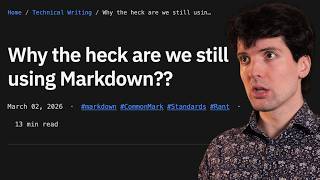

- Markdown behaves structurally similar to the C++ of markup languages, where nearly every output can be achieved through multiple, incompatible syntax paths.
- Parsing Markdown safely is exceptionally difficult because it requires implementing a full, secure HTML parser alongside the markdown logic.
- Treating a markup language as a pseudo-programming language without a formal foundation inevitably causes security regressions and system failures.
Back to Feed
Source Video
Why Markdown Has Become a Technical Liability
This discussion critiques the fundamental design, parsing challenges, and security vulnerabilities of Markdown as it is used in modern software development and documentation workflows. It argues that the language's lack of a clear, formal specification makes it an unsuitable, inconsistent foundation for complex, context-dependent system tasks.
Key Takeaways
- Markdown's original goal as a simple, human-readable tool has been undermined by feature creep and inconsistent, context-dependent grammar.
- The language suffers from severe technical debt, including widespread cross-site scripting vulnerabilities and unpredictable parsing behavior that complicates its use as a standard data format.
- Modern requirements for technical documentation have pushed Markdown beyond its original capabilities, forcing developers to implement complex, error-prone workarounds that mimic full-blown compilers.
Talking Points
Analysis
Why This Matters
Markdown is the backbone of the LLM ecosystem and developer documentation. Because agents rely on it as a primary output format, these underlying parsing flaws have propagated into mission-critical automated pipelines, creating an invisible layer of technical debt.
Who should care: Developers building agentic workflows, technical writers managing large-scale documentation, and security engineers auditing AI-generated content flows.
The Contrarian Takeaway
Markdown might actually be the wrong abstraction for the future of AI communication. If we continue to use a format that requires a 'compiler' just to render text, we are essentially building fragile dependencies on top of an unmanageable legacy design. We may eventually need a strictly defined, machine-first markup language that drops backwards compatibility with human-readable shorthand in favor of deterministic parsing.
Time saved:
Back to Feed