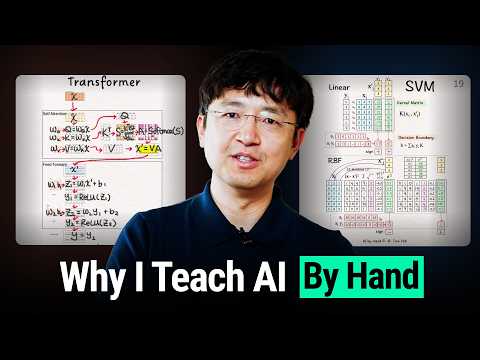
A CS Professor on Why Slow Learning Wins in the AI Era | CU Boulder, Tom Yeh

Video thumbnail: A CS Professor on Why Slow Learning Wins in the AI Era | CU Boulder, Tom Yeh
May 25, 202612m 38s video lengthEO

The Signal

Tom Diet, a University of Colorado Boulder computer science professor and founder of AI by Hand, argues that AI-era technical education should prioritize evergreen foundations over transient tools. The central tension lies in whether his blackboard-based, human-paced pedagogy is a superior response to modern cheating and skill decay; while he frames the current academic crisis as a systemic problem of incentives rather than specific tools like Chegg or AI, his methods remain a highly personal, advocacy-based model rather than a broad, proven standard.

The Case

  • Diet treats cheating as a symptom of broken institutional incentives rather than a product of specific platforms; he notes that cheating persisted even after Chegg was dismantled, proving that removing tools does not resolve the root cause.10:13
  • To force 'human-speed' learning and combat digital distraction, Diet taught an entire semester of C++ programming exclusively on a blackboard, arguing that handwriting math forces students to internalize concepts rather than skimming for answers.2:31
  • He cites matrix multiplication as an 'evergreen' foundation that has remained relevant across disparate waves of innovation, from Jurassic Park-era CGI to modern deep learning and quantum computing.4:10
  • Rebuilding one's technical foundation is essential for long-term career resilience; Diet describes his own struggle falling behind in deep learning, which he overcame by manually reconstructing the math on paper until he owned the knowledge.7:28
  • Hiring should be treated as a character-first process; Diet asserts that AI cannot transform a worker into a team player or a problem solver, so employers must prioritize those traits over raw tool proficiency.10:55
  • He uses the historic Gyeongbokgung palace in South Korea as a metaphor for skill-building: surface features may be destroyed or change, but a solid, original foundation allows for reliable reconstruction.5:37

The 1 Minute Signal Take

Diet's arguments for foundational mastery are compelling and grounded in the reality that today's cutting-edge frameworks are tomorrow's legacy debt, though his specific pedagogical method remains anecdotal. Watch this video if you want to understand the 'AI by Hand' philosophy firsthand, as his pacing and rhythm offer a rare, grounded alternative to the industry's typical hyper-speed, tool-fixated discourse.

Pro Analysis

Strategic Significance

This content highlights the growing dichotomy between 'tool-literacy' and 'domain-mastery.' It signals a shift back toward institutional skepticism of fast-evolving AI tools, suggesting that the competitive advantage in the workforce is shifting from immediate proficiency in AI to the ability to learn and reconstruct complex systems from first principles.

Who Should Care

  • Educators and curriculum designers struggling with academic integrity.
  • Hiring managers and HR leads currently overwhelmed by AI-generated resumes.
  • Lifelong learners seeking to optimize their study time for maximum long-term retention.

Contrarian Takeaway

The most non-obvious insight is the rejection of 'speed' in education. We are currently experiencing a cultural fetishization of velocity—AI lets you generate content, code, and insights faster. Diet suggests that in learning, speed is actually a deterrent to deep ownership, and that the only way to genuinely master an AI-driven future is to slow down significantly.

Time saved:10m 6s

Share this