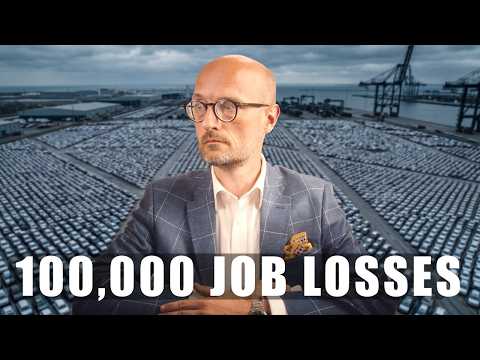
The Real Reason European Cars Can't Compete

Video thumbnail: The Real Reason European Cars Can't Compete
Jul 4, 202627m 31s video lengthPatrick Boyle

The Signal

Volkswagen’s crisis—marked by a 65% stock plunge and plans for massive layoffs—underscores a structural shift in Europe’s industrial base. Once a buyer of German machinery, China has become a formidable competitor, with Beijing’s export model now outpacing European incumbents in technology-intensive sectors despite attempts at trade protectionism and localized industrial policy.

The Case

The German Auto Crisis

  • Volkswagen executives are weighing up to 100,000 job cuts and four German factory closures, a move that directly contradicts a written guarantee given to unions in late 2024 to avoid closures until 2030.0:36
  • Restructuring acts as a stopgap: internal estimates suggest these cuts save roughly €1,000 per car, leaving a massive, unaddressed competitiveness gap against Chinese EV makers who currently hold a €6,000-per-car cost advantage.1:18

The China Shift

  • European trade-defense measures are proving ineffective; when the EU placed duties on Chinese EVs, imports of Chinese hybrids surged 155% almost overnight, illustrating the ease of product substitution.21:41
  • Chinese manufacturers are further bypassing tariffs by establishing assembly operations within underused European facilities, such as BYD’s reported negotiations for part of Volkswagen’s Dresden plant, effectively using EU subsidies to gain local market share.17:18
  • According to data from the Center for European Reform, Germany has been buying more capital goods from China than it sells there since mid-2025, signaling that Europe has lost its dominance in the high-end industrial sectors it once relied upon for export growth.10:02

The Policy Dilemma

  • Economists Brad Setser and Sander Tordoir suggest the EU needs a version of the U.S. Section 301 tool to address systemic distortions like currency undervaluation, rather than relying on slow, product-specific trade investigations.23:31
  • Proposals for broad tariffs—such as the French plan for a 30% levy on all Chinese imports—carry significant risks of retaliation; the speaker notes that the Smoot-Hawley Tariff Act of the 1930s preceded a 65% collapse in American exports within three years.22:20

The 1 Minute Signal Take

Europe’s industrial decline is driven by deep export displacement rather than internal bureaucracy alone, rendering incremental cost-cutting measures insufficient. The shift toward a protectionist "autarky" suggests that consumers should expect higher costs and lower industrial efficiency as firms prioritize local redundancy over global market integration.

Pro Analysis

Why It Matters

The collapse of the European auto sector signifies the end of the post-Cold War industrial order. It illustrates that com...

Full analysis always available on Pro.

Time saved:25m 32s

Share this

Tags