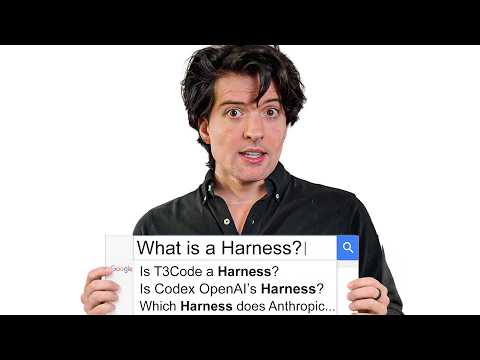
Are Harnesses Dead?

Video thumbnail: Are Harnesses Dead?
Oct 30, 202649m 30s video lengthTheo - t3․gg

The Signal

As software development shifts toward agentic workflows, the distinction between user-facing interfaces and backend execution harnesses has become a source of technical confusion. The speaker argues that harness differences are rapidly becoming negligible as model capabilities grow, making the obsession with specific execution wrappers a transitory phase in the industry's continuous abstraction ladder.

The Case

Taxonomy and Architecture

  • T3 Code is not a harness but an Agent Development Environment (ADE) that functions as a cross-harness interface; it sits above existing execution layers to orchestrate shared tooling via the Model Context Protocol (MCP).17:17
  • The speaker defines the current agent stack as a combination of an LLM, a harness for executing tool-calls, and the necessary context or prompting, asserting that modern agents can diagnose infrastructure issues—such as the pipeline flaws the speaker claims to have identified at Cloudflare—that previously went unnoticed.10:16

The Shift in Abstraction

  • The industry consistently migrates its "caring layer" upward, moving from assembly and languages to frameworks and now to AI-driven workflows; the speaker contends that developers who fixate on lower-level tools risk obsolescence.5:32
  • While users often express loyalty to specific model families or harnesses, the speaker estimates the actual performance gap between major offerings at only 3% to 5%, suggesting that users should choose based on price and capability rather than ideology.44:48

User Misconceptions

  • Support interactions reveal widespread user confusion where individuals assume that swapping a model within T3 Code should automatically carry over harness-specific skills or plugins, a misunderstanding that stems from the product effectively masking the underlying harness selection.40:54
  • The speaker describes T3 Code as a "food court" for harnesses, emphasizing that because tools and integrations are increasingly handled via external MCP data-planes rather than harness-local code, users should configure their environments accordingly.41:42

The 1 Minute Signal Take

The speaker’s thesis is that the utility of specialized harness layers is fading, and users should prioritize interface flexibility over rigid attachment to specific model-harness pairings. This analysis is valuable for understanding why the current agentic ecosystem is trending toward unified interfaces like T3 Code rather than further fragmentation.

Pro Analysis

Why It Matters

The transition from manual coding to agentic workflows is effectively a transition in the 'unit of work.' By clarifying t...
Full analysis always available on Pro.

Time saved:47m 36s

Share this

Tags

Written by: 1 Minute Signal Editorial Team