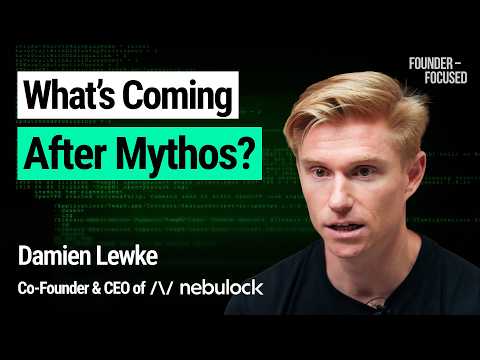
What you must know before Mythos arrives | Nebulock, Damien Lewke

Video thumbnail: What you must know before Mythos arrives | Nebulock, Damien Lewke
Jun 29, 202614m 54s video lengthEO

The Signal

Damien Lucius, the founder of the security platform Nebulo, argues that AI has drastically reduced the cost of cyberattacks, effectively collapsing the traditional talent gap into a subscription model. He contends that attackers now blend into normal network activity, making traditional alert-based tools obsolete and necessitating proactive, cross-tool threat hunting that assumes breach. His central argument is that the primary danger to businesses is not a catastrophic AI apocalypse, but the inaction of leaders during this narrow window of adaptation.

The Case

  • Lucius claims that AI has already automated the first three parts of the cyber kill chain—reconnaissance, phishing, and exploitation—while later stages like lateral movement still require human orchestration.8:50
  • Nebulo, which recently raised a $25 million Series A, was founded on the observation that even organizations using best-of-breed security tools end up compromised because point solutions miss threats hidden between layers.2:46
  • Attackers are increasingly using stolen credentials to log in during normal hours, creating actions that appear benign when viewed in isolation but emerge as malicious when analyzed in sequence.8:08
  • The company uses a fire marshal versus smoke detector analogy: while most alerts only signal after a fire starts, their platform is designed to inspect risk areas proactively to identify early warning signs like out-of-scope account access.10:53
  • Lucius identifies reconnaissance as costing effectively zero today, a stark shift that allows non-sophisticated actors to execute operations previously reserved for elite operators.9:19
  • The source asserts that US Cyber Command is already incorporating AI, though no documented evidence or specific operational details are provided to support the extent of this claim.4:43

The 1 Minute Signal Take

Lucius presents a compelling, if self-serving, thesis that aligns with the industry-wide frustration over high-spend, low-efficacy security stacks. While his specific claims regarding "Mythos"-level capabilities and mass-market "citizen hackers" rely on speculative forecasts rather than hard data, his operational critique of reactive alerting is well-grounded in his background at CrowdStrike and Arctic Wolf. Watch it if you want to understand the shift toward contextual security, but keep in mind that the video is an extension of a sales pitch.

Pro Analysis

Strategic Significance:

  • Traditional perimeter and endpoint security are becoming obsolete because modern attacks are defined by the misuse of legitimate access rather than the breaking of hard barriers. This shifts the focus from 'detecting intrusions' to 'detecting intent' through contextual sequence analysis.

Who Should Care:

  • CISOs and security researchers should care because the 'best-of-breed' appliance model is failing to catch threats that rely on human-like behavior. Developers and cloud engineers should care as attackers now prioritize access to their collaborative SaaS environments (like Google Workspace) as a primary entry point.

Contrarian Takeaway:

  • The most dangerous cyber threat is not the 'AI apocalypse' or super-intelligent autonomous systems, but the boring, slow, and stealthy blending of malicious intent with absolute normalcy by human-led operators using AI-augmented scripts.
Time saved:12m 29s

Share this

Tags