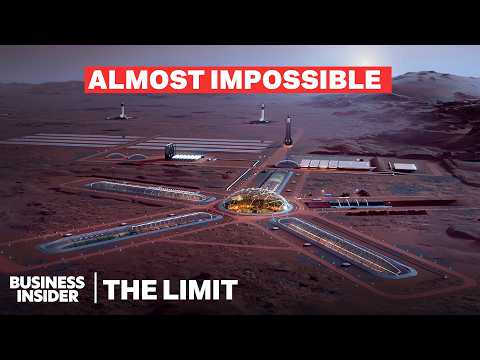
Why 6 Things Are Almost Impossible | The Limit

Video thumbnail: Why 6 Things Are Almost Impossible | The Limit
Jul 11, 20263h 38m 25s video lengthBusiness Insider

The Signal

Technological breakthroughs across skyscrapers, aviation, autonomy, geothermal power, and space settlement are currently hitting hard reality caps. While engineering often proves the possible, economic, biological, and regulatory friction creates a persistent gap between prototype success and scalable reality. The central tension is whether these systems are merely delayed or fundamentally constrained by physics and resource limits.

The Case

Infrastructure and Height

  • Burj Khalifa’s record height resulted from iterative wind-tunnel redesigns, adding 300 meters, rather than a single vision; experts suggest the current buttressed-core structural system likely tops out near 1.2 kilometers.2:25
  • The Burj spire acts as a height-gaming mechanic, accounting for 30% of its structure while remaining officially non-occupiable, illustrating why many of the world's tallest structures are fragile radio masts rather than skyscrapers.13:18

Speed and Flight

  • Passenger supersonic flight remains blocked by the 1973 overland boom ban and extreme fuel intensity, with sustainable aviation fuel costs threatening to push roundtrip prices to $5,000, of which nearly half could be fuel alone.35:47
  • NASA's X-59 project targets a noise reduction from a 105 dB sonic boom to a 75 dB 'thump,' though commercial viability depends entirely on whether this can be normalized and approved for overland flight.39:39

Autonomous Systems

  • Robo-taxi fleets are not fully autonomous; they are hybrid operational models relying on human remote agents—half of whom are often overseas—to manage edge cases like the widespread December 2025 San Francisco blackout.65:17
  • Public trust remains brittle because safety is judged incident-by-incident; singular high-profile failures, such as the dragging of a pedestrian or the death of a local cat, outweigh aggregate miles driven in public perception.76:02

Deep Geothermal and Space

  • Deep geothermal drilling faces a financing trap, requiring hundreds of millions in upfront capital before confirming well productivity, making it as much a bankability problem as a technical one.157:24
  • Space colonization is currently blocked by a stack of unresolved variables; beyond rocket economics, humans face unknown effects of partial gravity on physiology, toxic Martian regolith, and an unresolved legal regime for private governance.168:31

The 1 Minute Signal Take

The common thread across these domains is that technical achievement is rarely the final hurdle. Future scaling will be dictated by economic bankability, the resilience of hidden human support networks, and the slow, messy reality of biological and regulatory limitations.

Pro Analysis

Why It Matters

The video punctures the 'tech-will-fix-it' optimism cycle. By mapping the real-world constraints on six major technologies, it forces a shift from viewing these as 'imminent' to viewing them as 'constrained'—a critical distinction for investors, engineers, and policymakers.

Strategic Implications

The shift toward 'hybrid' systems—where human expertise is integrated with automation—is the dominant trend. Whether it is deep geothermal relying on oil-field rigs or robo-taxis relying on overseas remote agents, the future is less automation and more 'augmented operation.'

Evidence & Hype Audit

The content is highly rigorous, consistently distinguishing between established facts (e.g., structural records, flight physics) and speculative forecasts. It proactively identifies self-serving claims from companies like Waymo and Quaise, providing a necessary skepticism that anchors the technical claims.

Counterarguments

The strongest rebuttal to this content is the 'historical innovation' argument: technological breakthroughs often seem impossible until they occur. Supporters of rapid supersonic or space expansion would argue that massive government subsidies, as seen in the 1960s, could bridge the current capital and engineering gaps that the documentary labels as insurmountable.

Role-Specific Takeaways

  • Investors: Look for geothermal opportunities focused on direct heating rather than high-risk, 20km-deep electrical generation.
  • Policy Makers: Prioritize urban infrastructure redesigns for immediate safety impacts rather than awaiting the mass adoption of autonomous fleets.
  • Engineers: Pivot toward 'low-boom' and 'low-energy' design constraints rather than chasing maximum performance metrics.

What To Do Next

  • Conduct a 'constraint audit' on any project requiring a breakthrough to proceed.
  • Shift focus from total process automation to 'human-in-the-loop' reliability metrics.
  • Evaluate the carbon-lifecycle of required fuels and materials before committing to long-term adoption.
  • Investigate local-material utilization (ISRU) for any project requiring extreme structural or industrial deployment.
Time saved:3h 34m 59s

Share this

Tags

Written by: 1 Minute Signal Editorial Team