
Back to Feed
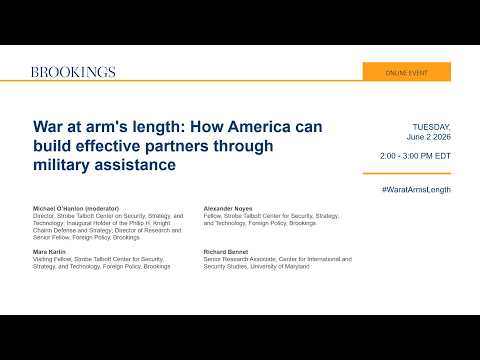
War at arm’s length: How America can build effective partners through military assistance
The Signal
Military assistance is a recurring U.S. security tool despite its history of mixed results, yet it remains bureaucratically cookie-cutter. The authors of "War at Arms Length" argue that success depends on two factors: interest alignment and defense-institution capacity. They contend that the U.S. must transition from a "weapons-first" approach toward "institutions-first" sequencing to avoid entrapment in misaligned missions.
The Case
- Interest alignment and partner institutional capacity are the two load-bearing variables for aid success; when both are absent, failure is likely.
- Ukraine is presented as the strongest contemporary evidence that decade-long institutional groundwork allows the U.S. to "move heaven and earth" rapidly when alignment is clear.
- Colombia is framed as a success after post-9/11 interest alignment and institutional reforms led to an estimated three-quarter drop in violence over 15 years.
- The Philippines is a qualified success: while U.S. forces achieved tactical gains against insurgents, sustained strategic alignment and defense-institution capacity only fully matured recently.
- Georgia is labeled a qualified failure because U.S. counterterrorism priorities diverged from Georgia’s territorial-defense needs, leaving the country poorly equipped for the 2008 Russian invasion.
- Policy recommendations advocate for more strategic selectivity, shifting toward building "unsexy" foundations like budgeting and logistics before delivering advanced weapons.
- The U.S. assistance system is flagged as too broad, currently touching 179 countries, often deploying generic programs that do not account for local mission constraints.
The 1 Minute Signal Take
The authors provide a logical, conditional framework that successfully demystifies why some military aid succeeds while other programs languish or backfire. While their advice to favor institutional reform over hardware is sound, they are less convincing on whether bureaucracy can be forced to abandon its preference for big-ticket weapons without significant congressional upheaval. Watch this video if you want the nuance behind the case studies; the summary is comprehensive, but the authors’ candid discussion of the "cookie-cutter" errors they see in current state-building programs offers useful context.
Time saved:
Back to Feed