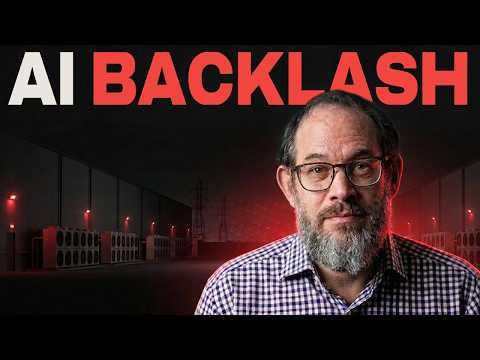
You Use AI Every Week. Voters Just Said Not In My Backyard.

Video thumbnail: You Use AI Every Week. Voters Just Said Not In My Backyard.
Nov 8, 202619m 32s video lengthAI News & Strategy Daily | Nate B Jones

The Signal

Recent election results confirm a widening chasm between the public's rapid adoption of AI and its staunch opposition to the local infrastructure required to power it. This tension is not crashing demand but is fundamentally shifting where compute is built, who captures value, and which firms remain viable in a constrained environment.

The Case

  • Widespread AI use persists despite political backlash: 65% of American adults used an AI chatbot weekly in May, yet a separate October poll shows 72% of Americans oppose new data centers in their communities.1:46
  • Google’s internal operations confirm supply is the primary bottleneck: the company reported API usage grew over 40% quarter-over-quarter and fourfold year-over-year, forcing it to outsource compute because Google Cloud capacity is maxed out.2:51
  • The election-driven slowdown creates a clear hierarchy of survivors: smaller "neocloud" startups—which rely on rapid installation of chips like GB300s—are highly vulnerable to permitting delays, while large incumbents with existing cash and infrastructure can wait out projects or buy distressed assets cheaply.3:46
  • Slower domestic construction may paradoxically stabilize the market: by providing demand more time to grow into existing capacity, the current political resistance may reduce the risk of a systemic AI supply glut previously feared for 2027.7:11
  • Regulatory uncertainty is accelerating alternative development paths: the speaker suggests that if US siting remains stalled, developers will increasingly pivot to offshore locations or potentially orbital compute, with the betting horizon for the latter shifting from 10 years down to roughly 6 to 8 years.11:10

The 1 Minute Signal Take

The backlash against data centers is not a rejection of AI utility but a fight over the physical cost of progress, creating a market where speed and site-level power access are now the primary competitive advantages. Investors should ignore press releases and watch capital allocation decisions to see which developers can actually deliver capacity in an increasingly restrictive landscape.

Pro Analysis

Why It Matters

The conflict between AI adoption and infrastructure siting is the first major 'real-world' check on the digital AI boom. It marks the transition from software-only scaling to the hard constraints of energy, land, and democratic consent.

Strategic Implications

  • Market Concentration: We are likely moving toward a 'barbell' market structure: massive, well-capitalized incumbents on one end and highly niche, geographically insulated players on the other, with the middle-tier neoclouds squeezed out.
  • Infrastructure as a Geopolitical Tool: Data centers will increasingly become a bargaining chip in foreign policy, with countries competing to host AI hubs in exchange for jobs and energy investment.

Evidence & Hype Audit

The content is highly credible regarding the tension between usage growth (Edison/SSRS data) and infrastructure resistance (ABC/WaPo/Ipsos data). It avoids the trap of claiming 'AI is over,' instead correctly identifying that the supply-side economics are changing. The speculation regarding orbital compute is the most speculative claim and should be viewed as an emerging sentiment rather than a near-term certainty.

Counterarguments

One might argue that the 'backlash' is overstated and cyclical—essentially a local negotiation tactic to extract better tax revenue from developers rather than an existential threat to AI expansion. If developers learn to 'play the game'—offering more generous local investment—permitting speeds might normalize faster than this analysis predicts.

Who Should Care

  • Infrastructure Investors: Focus on projects with pre-existing utility agreements.
  • Cloud Architects: Diversify compute dependencies to avoid single-provider failures.
  • Policy Strategists: Recognize that local control is becoming the primary bottleneck for national compute sovereignty.

What To Do Next

  • Analyze Q1/Q2 2027 capital expenditure reports to identify which firms are still aggressively acquiring land vs. renting capacity.
  • Audit your AI vendor list for 'neocloud' exposure.
  • Monitor international data center policy in Canada and Mexico for early movers.
  • Map your organization's compute reliance against regional US regulatory risks.
Time saved:16m 20s

Share this

Tags

Written by: 1 Minute Signal Editorial Team