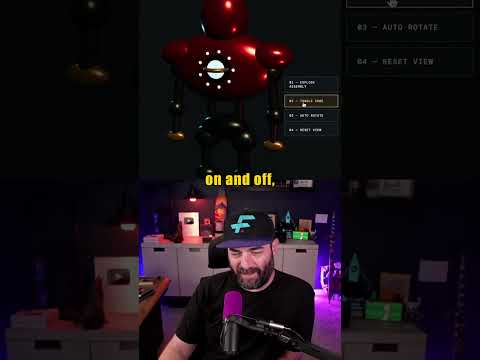
We’re getting closer to “Jarvis” everyday!

Video thumbnail: We’re getting closer to “Jarvis” everyday!
Aug 1, 20261m 8s video lengthMatt Wolfe

The Signal

Voice-based AI interfaces are shifting from passive chatbots to iterative agents capable of manipulating digital models via spoken commands. By demonstrating a 3D Iron Man suit that responds to real-time adjustments, the demo illustrates a move toward a 'personal Jarvis' user experience, though the actual scope and technical reliability of these models remain unproven.

The Case

Interactive Agent Workflow

  • The narrator demonstrates a spoken-command workflow where an AI iteratively modifies a 3D Iron Man model, responding to requests to rotate the image, inspect specific components, and toggle the suit's power core.0:11
  • Beyond visual rotation, the system executes functional parameter changes, such as resizing the helmet by 20% and adding solar panels to the back of the suit.
  • The demo serves as a proof of concept for multi-step agentic behavior, though the narrator acknowledges the output is 'not perfect yet,' suggesting the system is still prone to generation errors.0:41

Access and Framing

  • The narrator claims these voice capabilities are currently free to use on both the web and mobile applications for ChatGPT, with similar 'Plot Voice' features also available for free across all plans.
  • Paid tiers are said to offer higher usage limits and additional features, though the specific product name 'Plot Voice' may be a transcription error.0:58
  • While the video frames this experience as the arrival of a 'personal Jarvis,' this is a subjective analogy intended to highlight the novelty of conversational control rather than an objective measure of the AI's technical utility.

The 1 Minute Signal Take

This demo highlights the increasing capability of LLMs to act as iterative agents rather than just text engines, but viewers should treat the impressive visual output as a curated marketing narrative. Until proven in general applications, consider the 'Jarvis' experience a stylized preview of what is possible in restricted, demo-friendly environments.

Pro Analysis

Why It Matters

The transition from text-based chatbots to voice-controlled agents marks a fundamental shift in user interface design. By enabling spatial and structural manipulation of models through natural language, AI moves closer to becoming a creative force rather than just an informational retrieval system.

Strategic Implications

The ability to perform rapid, iterative design changes via voice is a game-changer for prototyping. Companies that integrate these interfaces into their existing 3D software stacks will likely capture significant developer and designer interest by reducing the friction of menu-diving and complex GUI interactions.

Evidence & Hype Audit

This content is highly biased toward promotional hype. While the demo shows impressive functionality, it is a curated interaction. The claim that the system can do 'whatever you ask' is demonstrably hyperbolic and lacks evidence. The transcript functions primarily as a showcase of a specific, narrow capability rather than a comprehensive evaluation of the AI agent's robustness.

Counterarguments

Critics would point out that voice commands are often less precise than manual parametric modeling. For professional-grade CAD or engineering, voice control may introduce unnecessary ambiguity and error compared to traditional keyboard/mouse inputs.

Who Should Care

  • Product Designers: For rapid prototyping and concept iteration.
  • AI Enthusiasts: To track the real-world utility of agentic workflows.
  • Software Developers: To understand the potential for voice-integrated UI/UX in generative platforms.

What to Do Next

  • Compare response accuracy between voice commands and text prompts for the same 3D modifications.
  • Explore the limits of the AI's spatial reasoning by requesting complex, non-standard structural additions.
  • Evaluate the platform's export capabilities to see if these 'magical' designs can be imported into professional software.
  • Document the specific failure modes when the voice agent misunderstands a spatial instruction.

Share this

Tags

Written by: 1 Minute Signal Editorial Team