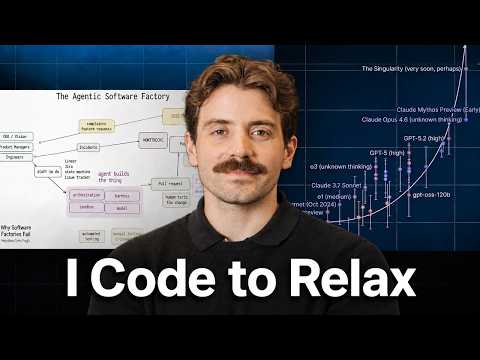
Vercel CEO reveals his Agentic Engineering Workflow

Video thumbnail: Vercel CEO reveals his Agentic Engineering Workflow
Oct 2, 20261h 37m 49s video lengthDavid Ondrej

The Signal

AI is shifting software value from raw coding to high-level orchestration, taste, and security. The central tension lies in whether companies treat AI as an autonomous productivity tool or a complex infrastructure layer; the speaker argues that while agents handle execution, human judgment remains the primary bottleneck for quality, brand, and risk-management decisions.

The Case

Security as a Core Constraint

  • Security is now a first-order AI problem; the speaker warns that latent vulnerabilities in human-written code are "immeasurable," making secure sandboxing and memory-safe languages like Rust essential to limit the blast radius of agentic workflows.0:06
  • The speaker points to a 9.8-severity Artifactory improper-authentication CVE as a potential pivot point for supply-chain exploitation, arguing that current security incidents in AI-assisted development are too opaque and demand more detailed trace transparency.89:29
  • While the speaker asserts that sandboxing could theoretically eradicate supply-chain attacks, this remains a forward-looking claim rather than an established technical guarantee.

Operational Strategy

  • Business quality is increasingly defined by resolution latency: organizations that can turn customer feedback into autonomous fixes demonstrate higher "agentic maturity" than those reliant on slow manual scrubs.13:02
  • The speaker emphasizes a shift in engineering focus toward "verification engineering"—the application of axioms and correctness constraints—to replace a reliance on trivial unit tests that often provide false confidence.40:20
  • Strategic advantage comes from model pluralism; companies should track token spend and use active benchmarking to select models based on fit for purpose rather than defaulting to a single provider.7:55

Tools and Execution

  • Cloud-hosted agents are viewed as inevitable for scaling large workloads, yet the speaker maintains that local CLI-based inspection is indispensable for technical deep-dives and maintaining a "microscope" on code.75:35
  • Minimalist, composable tools like the FX CLI are championed to reduce feature bloat and improve speed, favoring a Unix-philosophy approach that integrates into broader, agent-driven infrastructure.24:44

The 1 Minute Signal Take

The core takeaway is that AI-era leverage is gained through infrastructure and system design—sandboxes, gateways, and observability—rather than simple code generation. Builders should focus on narrow, high-alpha problems while treating security and verification as the foundation of their autonomous workflows.

Pro Analysis

Why It Matters

The shift toward agentic engineering represents a fundamental restructuring of the software labor market. By treating agents as the primary implementers, the premium on 'coding' collapses, while the premium on 'systems thinking' and 'verification' skyrockets. This is not just a productivity play; it is a change in the economic structure of software shipping.

Strategic Implications

Organizations that fail to build an 'AI-native operating fabric'—characterized by internal benchmarking, token-spend instrumentation, and automated security guardrails—will struggle to compete with leaner, agent-enabled rivals. The 'build vs. buy' calculus has changed; infrastructure primitives like gateways and sandboxes should be bought or adopted, while unique product differentiation should remain the sole focus of internal engineering efforts.

Evidence & Hype Audit

The content is technically grounded in existing trends (e.g., sandboxing, memory-safe languages, CLI-first workflows). However, it relies on several 'inevitability' claims that remain speculative. The security incident discussion, while compelling, is admittedly based on incomplete data, serving more as a call for future transparency than as a verified forensic report.

Counterarguments

The focus on cloud-sandboxed agents might be premature for smaller teams that value the simplicity of local environments. Furthermore, relying on AI for security 'verification' could introduce new, subtle types of bugs—specifically, 'proofs' that are technically valid but practically useless—if the human-defined axioms are flawed.

Role-Specific Takeaways

  • Engineering Leads: Stop measuring PR counts; start measuring signal-to-fix latency and automated test coverage.
  • CTOs: Implement strict model-usage tracking and invest in sandboxing infrastructure today to prevent future supply-chain exploits.
  • Founders: Resist the urge to build everything in-house; focus on deep alpha in your domain and leverage standard infra-layer primitives.
Time saved:1h 34m 38s

Share this

Tags

Written by: 1 Minute Signal Editorial Team