
Channel: Brookings Institution
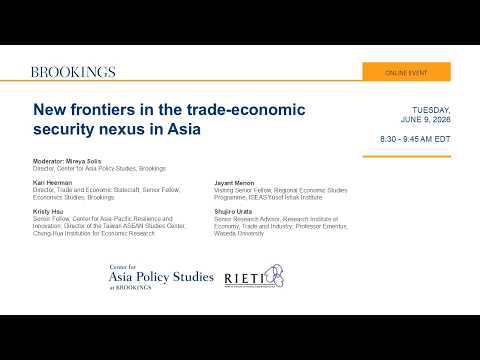
New frontiers in the trade-economic security nexus in Asia
The Signal
The Trump administration has pivoted U.S. trade policy in Asia from traditional, rules-based free trade agreements toward bilateral, reciprocal deals that exchange market access for strategic investment and economic-security alignment. This managed-trade framework effectively uses U.S. market leverage as a proxy for geopolitical containment, particularly regarding China-facing restrictions and supply-chain bifurcation. The agreements are contested: proponents argue they secure vital resilience in a volatile post-pandemic landscape, while critics warn they are coercive, legally fragile, and threaten to dismantle the multilateral trading system.
The Case
- The U.S. is trading tariff relief for concrete investment pledges, most notably Japan’s $550 billion package, and demanding alignment on export controls and China-facing restrictions.
- Taiwan’s reciprocal agreement remains politically divisive, as it commits the island to significant semiconductor relocation and import opening, while only impacting about 20% of its tariff-sensitive exports to the U.S.
- Southeast Asian partners like Malaysia and Cambodia are being drawn into these arrangements through a mix of market access incentives and punitive threats, including potential levies on goods containing high percentages of Chinese value-added.
- Unlike traditional trade deals, these arrangements lack formal dispute-settlement mechanisms, leaving enforcement to executive discretion and the changing winds of administrative power.
- Regional responses are currently split between forced compliance and strategies of diversification, such as the "China plus one" model and expansion of regional frameworks like the CPTPP to preserve rules-based trade.
- Legal durability for these deals is uncertain, particularly given recent Supreme Court rulings that have impacted the executive tariff authorities used as leverage during negotiations.
The 1 Minute Signal Take
The evidence indicates a clear, intentional shift toward managed, security-driven trade that prioritizes national strategic objectives over multilateral market liberalization. While the administration's leverage-based approach provides immediate tactical gains, the resulting lack of institutional durability and reliance on coercive alignment poses long-term risks to regional trust. Watch this video if you want the specific deal terms and regional political dynamics, but skip it if you only need the high-level takeaway that trade policy has fundamentally transitioned from commercial rule-making to an tool of economic warfare.
Time saved:
Tags
Channel: Brookings Institution