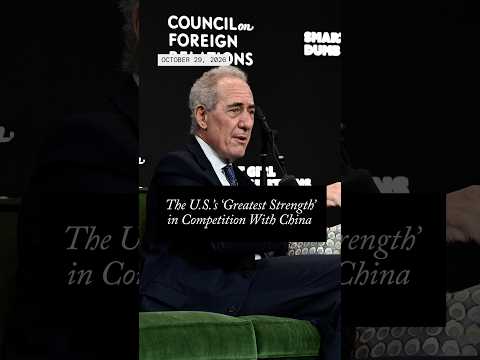
In Competition With China, Soft Power Is the U.S.’s ‘Greatest Strength’

Video thumbnail: In Competition With China, Soft Power Is the U.S.’s ‘Greatest Strength’
Nov 9, 20262m 19s video lengthCouncil on Foreign Relations

The Signal

American soft power—the influence generated by universities, culture, and values—is arguably facing its most significant erosion in decades. While the United States retains substantial residual strengths, it currently trails China in favorability ratings across most of 36 countries surveyed by Pew. This shift signals that the primary threat to U.S. influence may be domestic indifference rather than external geopolitical defeat.

The Case

The Erosion of Influence

  • Recent Pew Research Center data shows that China is now viewed more favorably than the United States in the majority of 36 surveyed countries, marking a reversal that has not occurred in nearly two decades.0:24
  • The speaker identifies American “indifference” as the greatest threat to national soft power, arguing that a withdrawal from active global engagement directly undermines U.S. strategic interests.2:03
  • While the U.S. continues to possess significant cultural and media appeal, this standing is increasingly viewed as a 'residual' strength rather than an unchallenged dominance.0:41

Universities as Strategic Assets

  • U.S. higher education functions as a long-term influence pipeline; foreign leaders who study in the U.S. often return to their home countries with favorable perceptions that serve as an irreplaceable strategic advantage.1:01
  • The speaker warns that restrictive student visa policies and uncertain federal R&D spending are prompting top international graduate students to consider alternatives in Canada or Europe.1:27
  • To prevail in strategic competition with China, the speaker maintains that the U.S. must avoid policy incoherence that inadvertently weakens the very institutions responsible for generating long-term global goodwill.

The 1 Minute Signal Take

The decline in U.S. global favorability is no longer a hypothetical risk but a documented shift. Maintaining American influence requires aligning immigration and research funding policies with the reality that universities act as a critical, long-term infrastructure for projecting national power.

Pro Analysis

Why It Matters

This analysis highlights that the greatest risk to U.S. hegemony is not external disruption but domestic policy incoherence. By treating soft power as a 'nice-to-have' rather than a critical component of geopolitical competition, the U.S. risks losing its primary diplomatic advantage: its cultural and academic magnetism.

Strategic Implications

True influence is built over generations through education and cultural exchange. Policy frameworks that prioritize short-term security or economic isolationism at the expense of international student mobility are effectively ceding future diplomatic ground to competitors. The U.S.-China competition is being fought as much in laboratories and lecture halls as it is in trade negotiations.

Evidence & Hype Audit

This content leans on a specific, high-quality data point (the Pew survey) but rests its broader argument on narrative-driven observations. It is less a quantitative policy brief and more a warning of strategic drift. The arguments are logical and historically grounded, but they lack specific metrics to prove that current visa policies are the primary cause of the observed shifts in favorability.

Counterarguments

Critics might argue that globalization has fundamentally changed; cultural influence is no longer as sticky as it was in the 1990s. Furthermore, some might posit that domestic policy must prioritize local needs over the cultivation of foreign elites, even at the cost of global soft power.

Recommendations

  • Conduct a strategic audit of visa processes for top-tier graduate researchers.
  • Increase public and private investment in R&D to ensure it remains globally competitive.
  • Re-evaluate current foreign policy to ensure engagement is persistent and not reactive.
  • Create alumni-focused diplomatic outreach programs for international graduates of U.S. institutions.
  • Connect university leadership with national security policy makers to bridge the gap between academic and diplomatic interests.

Share this

Tags

Written by: 1 Minute Signal Editorial Team