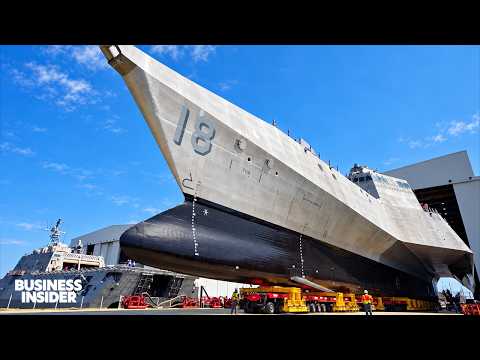
Inside America's $66 Billion Bet To Beat China's Shipbuilding Empire

Video thumbnail: Inside America's $66 Billion Bet To Beat China's Shipbuilding Empire
Oct 3, 202631m 6s video lengthBusiness Insider

The Signal

The United States faces a severe naval readiness crisis, with its shipbuilding capacity atrophied to the point that it produces at most five commercial ships annually compared to China’s 1,700. The tension between urgent national-security needs and a hollowed-out industrial base has triggered emergency outsourcing, major budget hikes, and foreign-led modernization efforts that remain unproven.

The Case

The Capacity Gap

  • The U.S. Navy remains roughly 60 ships short of its 2016 target of 355 battle force vessels, while China has scaled its fleet to over 400 ships.1:43
  • Shipbuilding in America is hampered by a shortage of approximately 250,000 skilled workers, with training pipelines often taking four years and costing millions for relatively small cohorts.4:53
  • The U.S. industrial base is so small that a single Navy vessel—such as the Expeditionary Fast Transport built by Austal USA, a major shipyard—can take over 30 months from initial steel cutting to delivery.3:10

Complexity and Cost

  • Lead-ship complexity, exacerbated by frequent mid-build design changes, causes recurring delays and cost explosions; the 11 most recent lead ships across the Navy exceeded their budgets by at least $8 billion combined.11:33
  • Supply-chain security is now a critical bottleneck, with a July 2026 mandate requiring exhaustive vetting of every component after a Senate investigation identified 1,800 suspected counterfeit parts.19:44
  • New warships are prohibitively expensive, costing four to five times more than those built in China or South Korea due to high labor costs, specialized coating requirements, and imported advanced systems.23:02

Policy and Foreign Assistance

  • Under an August 2026 emergency exception, the U.S. is allowing foreign firms to build two initial ships and up to three naval classes in exchange for investment in American yards and workforce training.17:35
  • South Korea, the world’s second-largest shipbuilder, has pledged $150 billion to modernize U.S. infrastructure, with companies like Hanwha Ocean already acquiring domestic yards to integrate their more efficient, robotic manufacturing methods.14:57

The 1 Minute Signal Take

The U.S. effort to rebuild its shipbuilding capacity is currently a high-stakes, capital-intensive experiment that struggles against structural realities like labor shortages and design instability. Whether increased funding and foreign partnerships can overcome a decade of industrial atrophy remains an open question, as the Navy faces an output gap that no amount of emergency policy has yet demonstrably closed.

Pro Analysis

Strategic Implications

The reliance on South Korean investment and the conditional outsourcing of naval production represent a fundamental shift in U.S. industrial policy. By trading proprietary naval work for foreign capital and production expertise, the U.S. is essentially acknowledging that its own industrial base has atrophied beyond the point of autonomous recovery. The success of this strategy hinges on whether domestic yards can absorb complex technical transfers without falling into the same 'first-of-class' delay cycles that have plagued recent programs like the Constellation-class frigate.

Evidence & Hype Audit

The content relies heavily on specific, internal metrics (workforce shortages, cost overruns, supplier counts) that paint a credible picture of systemic decay. However, the promotional claims regarding the planned 'battleship' program should be viewed with extreme skepticism. The lack of a demonstrated path to overcome the structural, labor, and budgetary constraints suggests that the most ambitious projections are currently more aspirational than realistic.

Counterarguments

Critics might argue that attempting to force-rebuild domestic shipbuilding at scale is a fool's errand. Instead, the U.S. could prioritize 'distributed lethality'—focusing on smaller, cheaper, and faster-to-build unmanned vessels that don't require the massive, high-overhead shipyards that have struggled for decades.

Who Should Care

  • Defense Contractors: Navigating the new traceability and auditing requirements is now a competitive necessity.
  • Naval Strategists: The capacity gap directly limits operational flexibility; redeploying ships between theaters is not a long-term solution.
  • Public Policy Analysts: The trade-off between the Jones Act protections and the need for global competitiveness remains an unresolved policy tension.

What to do next

  • Audit existing internal compliance systems against the new July 2026 supply-chain traceability mandate.
  • Assess the viability of shifting production to autonomous or semi-autonomous vessel designs that bypass legacy shipyard bottlenecks.
  • Monitor the integration progress of Hanwha Ocean’s investment into U.S. facilities as a bellwether for foreign-tech transfer efficacy.
  • Evaluate the impact of weather-related downtime on current labor retention and explore climate-controlled modular construction alternatives.
Time saved:27m 30s

Share this

Tags

Written by: 1 Minute Signal Editorial Team