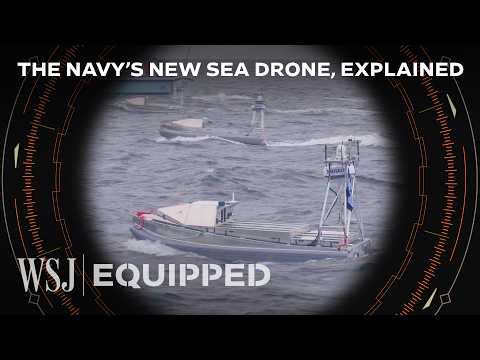
The Navy’s New Drone Boats Can Be Controlled From Anywhere on Earth | WSJ Equipped

Video thumbnail: The Navy’s New Drone Boats Can Be Controlled From Anywhere on Earth | WSJ Equipped
Jun 25, 20264m 13s video lengthThe Wall Street Journal

The Signal

The U.S. Navy is testing experimental Global Autonomous Reconnaissance Craft in the Baltic Sea, using Baltic-based NATO exercises to integrate drone technology into fleet doctrine. While the Pentagon defends its methodical, multi-role approach, a central tension exists: the U.S. remains in an experimental phase, while adversaries like Ukraine and Russia have already combat-tested sea drone fleets with proven lethality against naval assets. The Navy denies falling behind, but its domestic systems still struggle with basic autonomy, such as stopping or loitering when they lose radar track on a target.

The Case

  • During recent NATO training involving 6,000 sailors from 14 nations, the 16-foot, 2.5-ton GARK platform demonstrated a significant fragility: it frequently entered a loiter circle and stopped in the water whenever it lost its radar track on a follow-target.2:37
  • Although the Navy officially denies it is lagging behind adversaries, the transcript notes that Ukraine’s Defense Intelligence Agency has already used surface and underwater drones to damage or destroy over a dozen Russian ships in combat environments over several years.3:00
  • The Navy is expanding the craft's mission set beyond basic surveillance to include rescue and resupply, citing a recent incident where a similar drone, the Corsair, successfully rescued two U.S. service members after Iranian forces downed a helicopter near the Strait of Hormuz.1:32
  • Navy personnel assert that the platform can eventually handle "almost any mission," though this claim is speculative rather than demonstrated, as the current unit responsible for the program is only six months old.3:33
  • Observers note a persistent internal tension: while officials frame U.S. doctrine as inherently different from foreign competitors, the systems themselves remain in the testing phase and are not yet deployed in operational combat theaters.

The 1 Minute Signal Take

The video succeeds in contrasting the Navy's aspirational PR with the blunt reality of current technological failure, particularly regarding the drone's inability to maintain tracking. Watch it for the footage of the GARK's loitering behavior during exercises, which provides a clearer sense of the system's current maturity limits than any verbal briefing could.

Pro Analysis

Strategic Significance

This highlights a pivotal shift in naval warfare where low-cost, expendable autonomous platforms contest domains ...
Full analysis always available on Pro.

Time saved:2m 23s

Share this

Tags