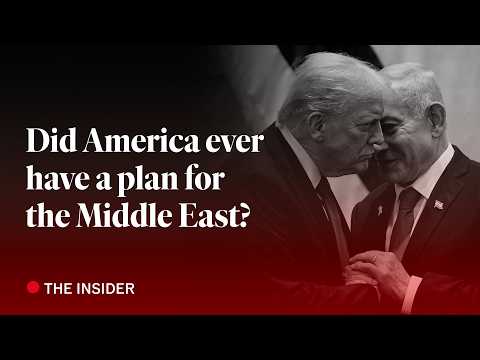
Did America ever have a plan for the Middle East? | The Economist

Video thumbnail: Did America ever have a plan for the Middle East? | The Economist
Sep 26, 20269m 39s video lengthThe Economist

The Signal

U.S. Middle East policy has been essentially reactive since the 2011 Arab Spring, lacking a coherent end-state while shifting from direct military intervention to a reliance on sanctions and regional proxy dynamics. This transition is not a simple withdrawal but a complex reconfiguration driven as much by regional states—who historically outsourced their security to Washington—as by shifting American interests. The core tension lies in whether this drawdown creates a power vacuum or merely reshuffles regional competition, leaving Gulf states caught between the risks of a resurgent Iran and the instability of a failing one.

The Case

Strategic Incoherence

  • U.S. involvement in the region is a legacy of oil dependence, ideological attachments to Israel, and long-standing security bargains where Gulf states traded oil access for American protection.0:04
  • Every U.S. president since 2011 has functioned reactively, lacking a strategic framework to replace the older, albeit unsuccessful, doctrines of the early 2000s.0:39
  • While the U.S. is militarily drawing down in Iraq, Syria, and the Gulf, it retains significant coercive influence through sanctions, which participants describe as having a substantial, ongoing impact on millions of lives.3:34

The Iran Dilemma

  • Iran’s internal power structure is currently opaque, with the status of Mojtaba Khamenei—the supreme leader's son who was reportedly nominated to succeed his father in March—remaining unclear after six months without a public sighting.4:54
  • The transcript disputes the "vacuum" model of regional conflict; experts argue that even when Iran and its proxies like Hezbollah, the Houthis, and various Iraqi militias are weakened, they are resilient enough to reconstitute or maintain power superior to that of local governments.8:17
  • Gulf states face a genuine strategic bind: a strong Iran threatens the Strait of Hormuz and regional trade, while a collapsed Iran could trigger refugee flows and failed-state spillovers that prove equally destabilizing.6:21

The 1 Minute Signal Take

The region is moving toward a post-American-military architecture, but Washington’s influence remains deeply embedded through non-military levers like sanctions. Because Iran’s succession remains a "black box," any diplomatic breakthrough is likely stalled, forcing regional powers into a high-stakes calculation about whether to accommodate an Iran that refuses to stay down.

Pro Analysis

Why It Matters

The video captures a pivotal moment of transition: the slow, often painful death of the 'Pax Americana' in the Middle Eas...
Full analysis always available on Pro.

Time saved:7m 41s

Share this

Tags

Written by: 1 Minute Signal Editorial Team