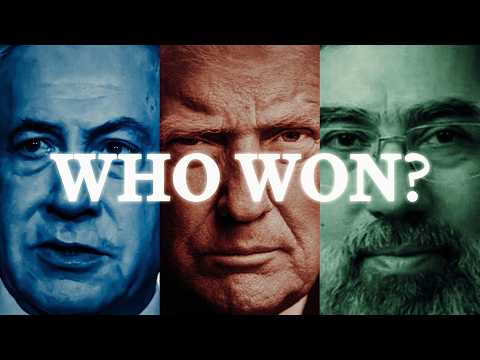
Who really won the Iran war

Video thumbnail: Who really won the Iran war
Jun 26, 202623m 19s video lengthMax Fisher

The Signal

The 103-day conflict between the U.S.-Israel coalition and Iran concluded with a signed agreement that effectively formalizes the nuclear status quo while granting Iran significant economic concessions. The central tension pits the coalition's public victory narrative—claiming the destruction of Iran’s nuclear and missile programs—against a transcript detailing a series of strategic failures, including the preservation of Iranian leadership and the failure of regional regime-change goals. Whether the agreement represents a total U.S. surrender or merely a pragmatic reset remains the primary point of dispute between the narrator’s assessment and the official coalition framing.

The Case

  • The U.S. goal to eliminate Iran’s nuclear program failed, as cited intelligence reports confirm only limited damage and maintain that Iran’s breakout time to build a weapon remains unchanged at roughly one year.5:08
  • Washington’s long-standing demand for zero Iranian missiles has shifted; Donald Trump, the U.S. president who initiated the strikes, now asserts it is "only fair" that Iran retain some missile capacity.7:05
  • The "Venezuela model" of regime change—intended to topple Iran's leadership and install a compliant successor—failed completely, leaving the existing Iranian government secure.9:21
  • Under the agreement, Iran secures immediate U.S. waivers for crude oil exports worth approximately $60 billion annually and gains potential access to $50–100 billion in frozen foreign assets.10:13
  • Iran’s strategic control over the Strait of Hormuz is effectively established, as the deal includes vague language regarding future maritime administrative fees that may allow Tehran to charge for transit after a 60-day window.20:11
  • Israel’s ongoing occupation of southern Lebanon, an area described as twice the size of Gaza, remains a point of friction that the U.S. has yet to resolve despite the ceasefire provisions in the signed agreement.14:32
  • Benjamin Netanyahu, the Israeli Prime Minister attempting to avoid a corruption trial, now faces negative public polling where 52% of Israelis surveyed suggest his war conduct has harmed the nation's interests.16:24

The 1 Minute Signal Take

The evidence provided overwhelmingly supports the transcript's conclusion that the coalition fell well short of its stated objectives while granting Tehran tangible economic and strategic gains. While the U.S. and Israel achieved some military impact, the disparity between their public victory claims and the actual terms of the agreement is stark and well-documented by the text itself. Skip this video unless you specifically need to observe the framing of the geopolitical scorecard; the text of the agreement and the intelligence summary are the genuine substance and are fully captured here.

Pro Analysis

Strategic Significance:

The war represents a rare moment where a major military intervention by global powers resulted in a net gain for the adversary. The inability of the U.S. to translate kinetic force into geopolitical compliance exposes a fundamental flaw in the 'regime change by force' model when applied to a resilient, unified state.

Who Should Care:

  • Geopolitical analysts: The war proves that conventional military dominance is increasingly unable to enforce political outcomes against determined middle powers.
  • Investors in energy markets: The formalization of Iranian control in the Strait of Hormuz and the introduction of new financial 'administrative fees' create long-term uncertainty for global shipping.

Contrarian Takeaway:

The most significant outcome of the war is not the military damage, but the U.S. public endorsement of the Iranian nuclear status quo. By signing a document that keeps the program in its current state 'pending a final deal,' the U.S. inadvertently stabilized the regime it spent 103 days trying to topple.

Time saved:20m 23s

Share this

Tags