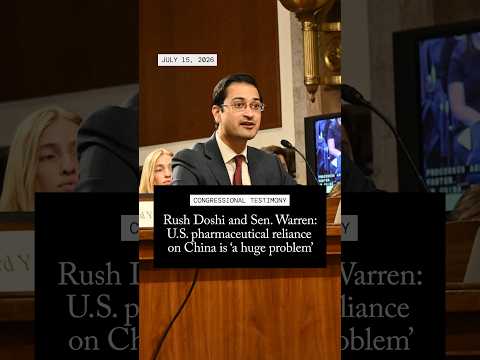
Rush Doshi and Sen. Warren: U.S. pharmaceutical reliance on China is ‘a huge problem’

Video thumbnail: Rush Doshi and Sen. Warren: U.S. pharmaceutical reliance on China is ‘a huge problem’
Jul 29, 20261m 2s video lengthCouncil on Foreign Relations

The Signal

Federal procurement policy in the United States currently prioritizes low cost over supply-chain resilience and product quality, inadvertently reinforcing dependence on China for critical raw materials. Proponents argue that the government’s massive scale is an underused lever that could incentivize domestic manufacturing simply by providing stable, predictable demand.

The Case

The Mechanism for Change

  • The U.S. government possesses massive purchasing power that is currently optimized primarily for minimizing price, effectively ignoring upstream risks.0:14
  • Procurement agencies are not incentivized to account for reliance on specific foreign raw materials or active ingredients in the medications they buy.
  • Providing stable, predictable demand is proposed as the primary mechanism to attract domestic manufacturers and build the supply-chain resilience currently missing from the market.0:53

Feasibility and Tradeoffs

  • The marginal price difference for many generic drugs is often limited to only a few cents, suggesting that shifting procurement criteria might be feasible without significant added cost.
  • There is no consensus or evidence provided in the source to confirm that modifying procurement rules would meaningfully reduce dependence on China or improve resilience at broad scale.0:36
  • The proposal to use federal purchasing to set industry-wide standards remains an aspirational theory rather than a tested policy with documented outcomes.

The 1 Minute Signal Take

The core issue is whether shifting government buying incentives can actually secure domestic supply chains at an acceptable cost. You should treat the claim that this reform is “inexpensive” as a specific, limited observation about generic pricing, not as a guaranteed result for the entire pharmaceutical sector.

Pro Analysis

Why It Matters

The reliance on foreign active ingredients for essential medications introduces a systemic risk to the U.S. healthcare infrastructure. If supply chains are disrupted, the government has no immediate fallback due to the lack of domestic capacity and the absence of prior procurement planning.

Strategic Implications

The shift from a 'lowest-cost' to a 'resilient-supply' sourcing model represents a transition toward industrial policy. By leveraging size, the U.S. can effectively force a market correction in sectors where commercial actors previously found no incentive to diversify.

Evidence & Hype Audit

This content is essentially a high-level policy proposal. It lacks empirical evidence demonstrating that current private-sector actors cannot or will not adapt without such interventions. It is not 'hype' per se, but it is a speculative argument for government-led market shaping.

Counterarguments

One risk is 'regulatory capture' or inefficiency, where government-mandated procurement leads to higher costs and lower innovation over time. Another counter-point is that China’s comparative advantage in chemical manufacturing is structural and cannot be overcome simply by changing purchasing rules, potentially requiring massive subsidies instead.

Who Should Care

  • Procurement Officers: Need to update RFPs to include supply-chain transparency requirements.
  • Policy Makers: Should evaluate if the current procurement system is working against national security goals.
  • Pharmaceutical Logistics Leaders: Must prepare for potential shifts in federal contract standards that favor resilient sourcing.

What to Do Next

  • Conduct a supply-chain audit of all active pharmaceutical ingredients.
  • Define 'resilience' metrics for future federal drug contracts.
  • Analyze cost-impact studies comparing current vs. resilience-first procurement.
  • Implement pilot programs in non-critical drug categories to test demand stability models.

Share this

Tags

Written by: 1 Minute Signal Editorial Team