
Back to Feed
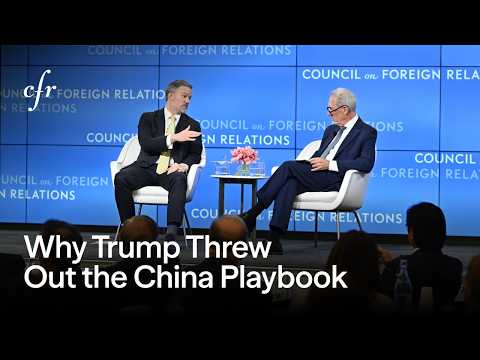
Why the U.S. Has ‘Mostly’ Given Up on Trying to Get China to Reform Through Trade
The Signal
A senior Trump administration official characterizes the recent Beijing trade meeting as a successful transition to a stability-focused, managed-trade relationship rather than an attempt at systemic economic reform. The core dispute remains whether the modest trade outcomes secured—including preserved tariffs and specific export targets—constitute a hard-won victory or an empty abandonment of long-term U.S. goals.
The Case
- The U.S. successfully maintained its existing tariff regime on China while securing commitments for 200 Boeing aircraft and $17 billion in agricultural exports, which the speaker presents as evidence that the administration achieved its intended objectives.
- The speaker justifies this shift toward 'managed trade' by arguing that previous, decades-long efforts to force China to abandon state-led industrial subsidies and export-oriented growth models were ineffective and are now largely considered impossible to achieve.
- A previously proposed, broader first-term agreement—which would have addressed deep structural economic issues—reportedly reached the top levels of the Chinese government only to be returned completely 'redlined,' signalling a refusal to reform state control.
- New bilateral mechanisms, described as a 'board of trade' and a 'board of investment,' were established to manage the relationship and oversee continued access to rare earth elements, which the speaker frames as mitigating a critical supply-chain choke point.
- The U.S. has set an aspirational market-access target of $70 billion in agricultural exports beyond current soybean volumes, a goal the speaker acknowledges requires China to remove specific regulatory registrations and non-tariff barriers.
- During the talks, the Chinese leadership reportedly expressed a refusal to accept tolling in the Strait of Hormuz and reiterated support for the denuclearization of the Korean Peninsula, though these items remain peripheral to the primary trade-focused agenda.
The 1 Minute Signal Take
This is a candid, if self-serving, admission that the administration has dropped its core objective of inducing structural change in the Chinese economy in favor of transactional stability. The speaker is arguably correct that systemic reform was never a realistic near-term card to play, so watch this if you want to understand the current administration’s shift toward pragmatic, outcome-based dealmaking over ideological confrontation. Skip the video if you only care about the specific trade figures, which are fully covered here.
Time saved:
Tags
Back to Feed