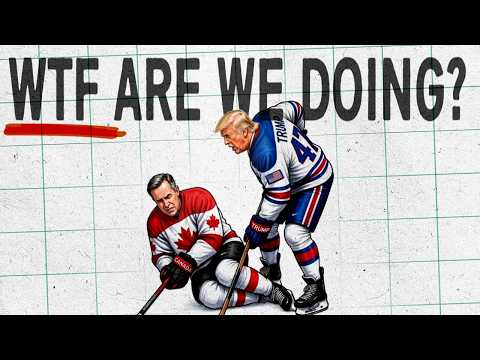
Bruh... Leave Canada Alone

Video thumbnail: Bruh... Leave Canada Alone
Sep 19, 202616m 28s video lengthHow Money Works

The Signal

The US-Canada relationship, historically an exceptionally close security and economic alliance, has deteriorated into a cycle of aggressive trade volatility and symbolic antagonism. While the US currently pursues a protectionist agenda characterized by tariffs and threats, the core tension lies in a fundamental contradiction: the US is attempting to penalize a partner upon which it remains structurally dependent for energy and critical industrial materials. This strategic mismatch risks long-term economic damage and the alienation of a vital ally, potentially pushing Canada to diversify its supply chains toward global rivals like China.

The Case

The Economic Reality

  • Canada is not merely a trade-surplus counterpart but a critical upstream input supplier; it accounts for roughly 60% of all US crude oil imports and 73% of crude for Midwest refineries.8:05
  • The goods-deficit framing is misleading because it ignores a $28 billion annual US services-trade surplus, where US firms export high-margin financial, technical, and consulting services to Canadian counterparts.4:53
  • Blanket tariffs are portrayed as self-defeating because they hit integrated supply chains multiple times; one component may travel between the US, Canada, and Mexico across several borders, compounding tariff costs at every crossing.3:48
  • The US remains heavily dependent on Canada for essential resources that cannot be easily replaced, including 80% of imported potash—a fertilizer backbone for US agriculture—and roughly 68% of US aluminum imports.10:41

Conflict and Leverage

  • Canada has shifted from passive partner to active retaliator, imposing over $20 billion in tariffs and an Ontario-led 25% surcharge on electricity exports that powers 1.5 million US homes and businesses.12:00
  • Strategic leverage remains asymmetric; while Canada holds roughly $460 billion in US Treasury securities, public opinion polling shows 73% of Canadians support retaliatory measures compared to only 57% of Americans who oppose the tariffs, suggesting higher political durability for Canada's stance.12:26
  • Canadian energy infrastructure is evolving, with expanded pipeline capacity now directing more oil toward Asian markets, a diversification move accelerated by US diplomatic unreliability.9:53

The 1 Minute Signal Take

The current US policy of leveraging tariffs against Canada ignores the reality that the two economies are physically and industrially fused. If the goal is to counter China, the US is arguably failing by attacking its own upstream suppliers, effectively trading high-margin economic stability for symbolic political wins.

Pro Analysis

Why It Matters

The deterioration of US-Canada trade relations represents a fundamental shift from a 'team-based' North American industrial model to a zero-sum, mercantilist approach. This pivot risks the integrity of the US energy grid and the viability of highly integrated manufacturing supply chains.

Strategic Implications

US policymakers are currently using tariffs as a blunt instrument for political signaling, which creates long-term structural risk. By incentivizing Canada to build out independent export infrastructure and refine its own raw materials, the US is inadvertently encouraging a reduction in continental energy integration. This shift makes the US market more vulnerable to global supply shocks.

Evidence & Hype Audit

The content relies heavily on specific, verifiable trade and energy data (e.g., import percentages, services surplus figures). While the speaker’s framing is strongly critical of current US policy, the evidence provided regarding supply-chain mechanics and resource dependence is robust and widely supported by standard economic theory on integrated trade.

Counterarguments

Supporters of the current US trade stance might argue that 'temporary' pain is necessary to force a long-term re-negotiation of trade terms to prevent the hollowing out of domestic industries. From this view, temporary disruptions are a strategic cost for achieving greater autonomy.

Who Should Care

  • Manufacturing Executives: To model cost volatility in cross-border supply chains.
  • Energy Policy Analysts: To track the security implications of reduced North American energy reliance.
  • Investors: To monitor potential financial instability from shifts in foreign holdings of US government debt.

What to Do Next

  • Conduct a supply-chain audit to identify exposure to Canadian cross-border tariff points.
  • Monitor Trans Mountain pipeline utilization rates as a proxy for Canadian export diversification.
  • Assess the impact of electricity export surcharges on Midwestern regional industrial costs.
  • Evaluate the feasibility of reshoring specific mineral processing (potash/aluminum) to mitigate import risk.
Time saved:12m 59s

Share this

Tags

Written by: 1 Minute Signal Editorial Team

Bruh... Leave Canada Alone | 1 Minute Signal