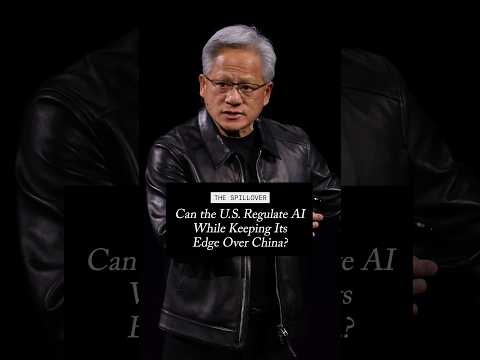
Can the U.S. Regulate AI While Keeping Its Edge Over China?

Video thumbnail: Can the U.S. Regulate AI While Keeping Its Edge Over China?
Nov 13, 20261m 54s video lengthCouncil on Foreign Relations

The Signal

AI policy must move beyond the current binary of innovation versus regulation, according to the speaker. The central thesis is that the U.S. and its allies can only effectively define global AI rules if they maintain frontier technical leadership, rejecting the idea that companies can govern themselves or that advancement must be sacrificed for safety.

The Case

Strategic Governance

  • The speaker argues that governance cannot be left to corporate self-regulation and must be paired with active frontier technical leadership to maintain geopolitical rule-setting power.0:43
  • Global cooperation is presented as a necessity due to shared interests, though the speaker offers no specific mechanism for how the U.S. and China might coordinate amid intense competition.0:11
  • The claim that innovation and governance can coexist is presented as a strategic imperative, with the speaker suggesting the world must find ways to advance both simultaneously rather than accepting a trade-off.

Scope and Deployment

  • Policy focus is currently too narrow, as the speaker asserts that smaller, distilled models—not just frontier AGI-superintelligence systems—hold significant power for both military and civilian use cases.1:20
  • Attention should shift toward how AI is adopted and diffused across the economy, as these practical applications determine the eventual distribution of power.1:40

Contextual Note

  • The video includes an unverified, unsubstantiated reference to an alleged affair involving the CEO of NVIDIA—a massive semiconductor firm—and the woman running a company called Megaspeed; this claim remains entirely undeveloped and lacks substantive relevance to the policy discussion.

The 1 Minute Signal Take

The speaker’s argument prioritizes state-led strategic dominance over industry-led governance, positing that technical superiority is the prerequisite for regulatory influence. Readers should interpret the emphasis on 'distilled models' as an attempt to reframe the AI policy agenda to account for real-world deployment rather than just experimental frontier safety.

Pro Analysis

Strategic Implications

The central tension identified is the 'governance paradox': the more a state regulates to achieve safety, the more it risks creating a strategic disadvantage that eventually hands regulatory dominance to its rivals. By asserting that rule-setting power is a function of technological leadership, the speaker shifts the debate from a moral question of 'should we regulate' to a realist question of 'who gets to define the future of the global stack.'

Evidence & Hype Audit

This content is highly normative and strategic rather than empirical. It relies on the assertion that 'power' follows the cutting edge, which is a common geopolitical assumption but remains unproven in the context of specific AI architectures. The mention of NVIDIA is clearly flavor-text or distraction, devoid of evidence, and serves to anchor the discussion in familiar corporate rivalries rather than technical substance.

Counterarguments

Critics of this 'frontier-first' approach would argue that technological leadership does not guarantee normative influence. If a country leads in development but uses that power to create closed or proprietary standards, it may trigger an aggressive 'balkanization' of AI, forcing other nations to develop alternatives that intentionally ignore U.S.-led governance frameworks.

Who Should Care

  • Policymakers: To recognize that 'safety' regulation that kills local R&D is a self-defeating geopolitical strategy.
  • Defense Planners: To recognize that the next generation of power may come from 'distilled' models in theater rather than just the most expensive frontier foundation models.

What to Do Next

  • Map the critical use cases where distilled models are currently influencing military operations.
  • Develop a framework for international standards that focuses on 'interoperability for safety' rather than 'coordination for control.'
  • Quantify the R&D delta between frontier labs and the next tier of accessible distilled models.
  • Evaluate which specific institutional bodies are best positioned to act as a bridge between technical innovators and regulatory oversight.

Share this

Tags

Written by: 1 Minute Signal Editorial Team