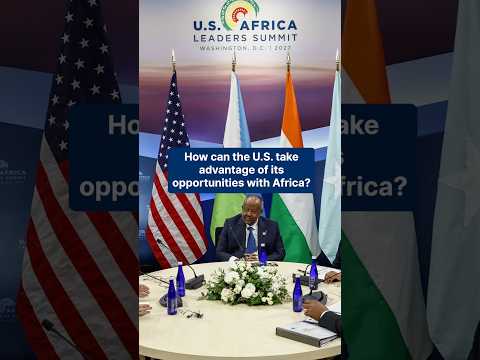
How can the U.S. take advantage of its opportunities with Africa?

Video thumbnail: How can the U.S. take advantage of its opportunities with Africa?
Sep 15, 20261m 54s video lengthBrookings Institution

The Signal

Current US-Africa policy is facing a legitimacy crisis, as critics argue that Trump administration cuts to USAID and foreign assistance have eroded African trust in American reliability. The debate centers on whether the transition to a new multi-year compact model offers a path toward sustainable partnership or a tool for geopolitical coercion.

The Case

Strategic Shifts

  • Critics contend that slashing foreign aid has left African nations feeling abandoned, framing the current US administration as an inconsistent partner that prioritizes isolation over engagement.0:26
  • The proposed shift from an aid-based model to an 'aid-to-trade' framework is presented as a necessary evolution, intended to treat African countries as economic partners rather than passive recipients.0:43
  • Proponents of the new multi-year compact model advocate for explicit, long-term agreements that clearly define US obligations, partner country responsibilities, and specific endpoints for assistance to foster eventual self-sufficiency.

Implementation Risks

  • A significant, albeit unproven, concern exists that the compact mechanism could be weaponized to extract unrelated concessions, specifically third-country transfer agreements and mineral deals.1:18
  • While the technical structure of these compacts is theoretically sound for creating predictability, the potential for coercive side deals that ignore African interests remains a central point of contention for policy observers.

The 1 Minute Signal Take

The core issue is an asymmetry between the stated goal of professionalizing aid through transparent, bounded compacts and the risk that these agreements act as leverage for extractive side deals. If the US cannot address the perception of unreliability caused by recent funding cuts, the shift to a trade-centered partnership may struggle to gain genuine traction with African leaders.

Pro Analysis

Why It Matters

The pivot in U.S.-Africa policy is critical because geopolitical influence is shifting toward economic integration. If the U.S. continues to view the region primarily through a lens of aid or extraction, it risks losing long-term access and influence to more persistent global competitors.

Strategic Implications

The shift toward 'aid-to-trade' reflects a recognition that aid creates a dependency trap that often stalls institutional development. By forcing an 'exit date' into agreements, the U.S. encourages local leadership to build autonomous capacity, which is inherently more stable than constant external funding.

Evidence & Hype Audit

This content is a high-level policy critique rather than a data-driven analysis. The claims regarding the 'weaponization' of compacts for mineral deals lack specific corroborating evidence. The listener should interpret the speaker's warnings as valid political concerns rather than established systemic facts.

Counterarguments

Critics of the 'exit date' model might argue that rapid withdrawal of assistance—even with planning—could destabilize fragile states, leading to security vacuums or immediate economic contraction in regions where institutions are not yet ready for full independence.

Who Should Care

  • Policy Analysts: Focus on the structural shift from aid to trade.
  • Diplomats: Monitor the alignment between policy rhetoric and on-the-ground negotiation.
  • Business Leaders: Watch for the 'aid-to-trade' signal as an indicator of where to focus investment efforts.

What to Do Next

  • Conduct a gap analysis between current aid agreements and the proposed 'multi-year compact' model.
  • Audit existing bilateral agreements for hidden conditionalities or third-country concessions.
  • Establish clear success metrics that define 'readiness' for the end of aid.
  • Prioritize trade-facilitation investments over traditional grant-based programs.
  • Engage with local African stakeholders to ensure the 'partnership' framing is reflected in actual negotiation processes.

Share this

Tags

Written by: 1 Minute Signal Editorial Team