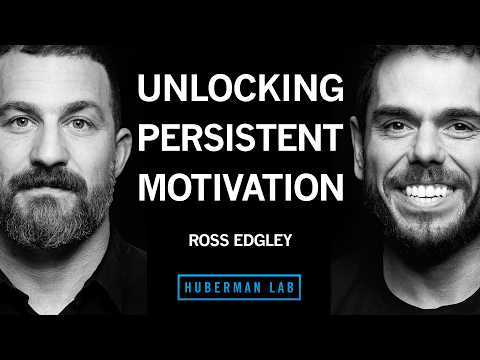
Unlocking Persistent Motivation & Extreme Resilience | Ross Edgley

Video thumbnail: Unlocking Persistent Motivation & Extreme Resilience | Ross Edgley
Oct 26, 20262h 43m 38s video lengthAndrew Huberman

The Signal

Ross Edgley — a professional ultra-endurance athlete known for circumnavigating Great Britain and swimming hundreds of miles in remote rivers — argues that human persistence is not a singular trait of willpower, but a dynamic system of rotating motives. Along with neurobiologist Andrew Huberman, he explores how these mental "spokes," coupled with deliberate physical preparation and team-based risk regulation, allow him to endure extreme, life-threatening conditions.

The Case

The Mechanics of Motivation

  • Edgley uses a "spokes" model of motivation, rotating through distinct drivers like fear of shame, family legacy, career necessity, and defiance because no single motive remains potent indefinitely.14:44
  • Family is his most durable fuel, evidenced by his urgent final 100-mile push in Iceland to reach his first son’s birth, as well as his father’s refusal to stop coaching wheelchair tennis despite a terminal cancer diagnosis.21:44
  • Huberman explains these behaviors through brain circuits like the anterior mid cingulate cortex and prefrontal cortex, though he cautions that the exact mathematical computations governing these pathways remain unknown.11:57

Performance and Risk

  • Edgley’s training philosophy prioritizes connective tissue robustness and strength reserve over traditional high-volume swim technique, as he believes tendons and ligaments are the primary limiting factor for long-duration durability.106:42
  • He now delegates stop/go decisions to a support team because he admits he will otherwise push himself to the point of hospitalization, a reality he experienced during past bouts of rhabdomyolysis and severe hypothermia.39:28
  • Performance in endurance is highly context-dependent; Huberman warns against the assumption that training "toughness" in one domain, such as cold exposure, automatically generalizes to other stressors like social or cognitive tasks.103:26

The 1 Minute Signal Take

Persistence is a managed, modular system rather than a fixed personality trait. You should build a repertoire of motivators to rotate when one fails and, if the stakes are high, outsource judgment to others to prevent over-arousal and self-destructive overextension.

Pro Analysis

Why It Matters

This discussion bridges the gap between raw, anecdotal human performance and the emerging neuroscience of volition. It provides a blueprint for individuals who are not professional athletes but struggle with maintaining high output over extended periods, offering a framework that replaces the "magical" view of willpower with a mechanical, circuit-based reality.

Strategic Implications

The shift from 'singular motivation' to 'motive rotation' is a critical strategic pivot. It moves the user from a state of fragile dependency on a single emotional wellspring (like "passion") to a robust system that can withstand the inevitable burnout of long-term projects.

Evidence & Hype Audit

  • Trustworthiness: High, provided the neuroscience is understood as preliminary. Huberman is careful to distinguish between established rodent/VR models and the speculative math of human ACC function.
  • Hype Factor: Low. Edgley’s claims are grounded in self-reported lived experience, which he frames as a working model rather than universal dogma.

Counterarguments

The primary counterpoint is that 'motive rotation' might lead to a lack of deep, singular purpose—a hallmark of true masters. Critics might argue that jumping between spokes creates a shallower commitment to the work compared to someone who possesses a singular, obsessive drive.

Role-Specific Takeaways

  • For Leaders: Model Edgley’s team-based risk management. Ensure your direct reports feel safe to call out 'stop' criteria, even if you are the one driving the initiative.
  • For Creatives: Use the "cyclops mode" of narrow attention when execution is difficult, but cultivate panoramic awareness to avoid burning out on long-term, low-visibility tasks.

What to Do Next

  • Conduct a "spoke audit" of your current projects: what fuels you, and what happens when that fuel runs out?
  • Establish an "outsource point" for your biggest projects—a partner or mentor who has the authority to tell you when to rest.
  • Replace one high-volume aerobic/repetitive workout per week with a 45-minute strength/connective-tissue focused session.
  • Adopt the 2-5 a.m. rule: never make a permanent judgment based on an overnight or sleep-deprived state.
Time saved:2h 40m 20s

Share this

Tags

Written by: 1 Minute Signal Editorial Team