
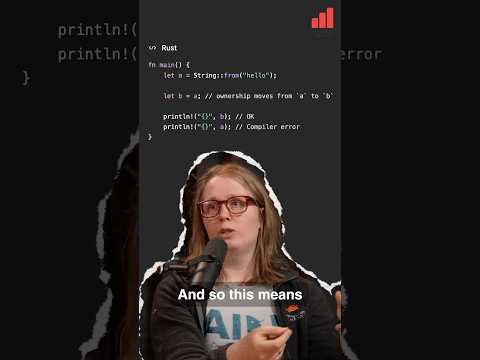
- Rust prevents double cleanup by mandating unique ownership at every scope exit.
- Assigning a value to a new variable in Rust constitutes a move that invalidates the previous owner.
- Garbage-collected languages permit multiple references because cleanup is deferred, separating object lifecycle from variable scope.
Back to Feed
Alice Ryhl: Rust’s ownership model
The video explains how Rust manages resource cleanup through an ownership system that uses move semantics instead of a garbage collector.
Key Takeaways
- Rust enforces ownership transfer via move semantics when reassigning variables like strings.
- Moving a variable between identifiers disables the original, preventing invalid double resource cleanup.
- Unlike garbage-collected languages, Rust handles automatic, scope-based resource release without deferring memory management.
Talking Points
Analysis
Strategic Significance:
- By shifting memory management responsibility to the compiler via ownership, Rust eliminates runtime overhead while guaranteeing safety, a critical balance for low-level systems programming.
Who Should Care:
- Systems engineers and developers transitioning from higher-level languages who need to understand how to manage memory without relying on runtime garbage collection overhead.
Contrarian Takeaway:
- Rust’s strict ownership rules are often criticized for their steep learning curve, yet this constraint is the primary mechanism that prevents common memory-related security vulnerabilities, essentially trading developer convenience for architectural immunity against illegal resource states.
Back to Feed