
Why It Matters
Model collapse threatens the long-term utility of generative AI by creating an 'echo chamber' effect. If the foundational data for future models becomes increasingly contaminated by past AI output, we risk a stagnation of human knowledge and an amplification of existing biases, rendering AI less reliable for specialized or nuanced tasks.
Strategic Implications
Organizations building AI pipelines must shift focus from 'more data' to 'better data.' Provenance tracking is no longer optional; it is a strategic requirement to ensure the data supply chain remains clean. Furthermore, reliance on RAG (retrieval augmented generation) provides an essential fallback, allowing models to query the real world rather than relying solely on potentially degraded internal weight structures.
Evidence & Hype Audit
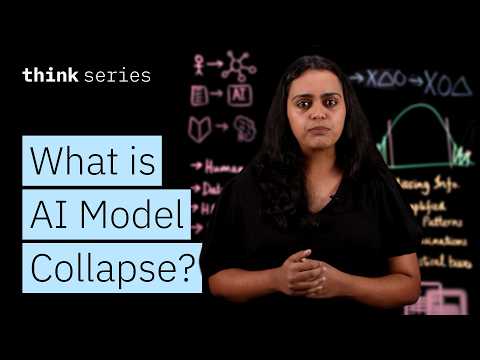
The content relies on well-documented experimental mechanisms for model collapse but rightfully distinguishes this from the 'unsettled' status of industry-wide catastrophic failure. The narrator displays a slight bias toward 'existential' framing, yet the technical explanation of 'tail compression' provides a solid, verifiable theoretical foundation.
Counterarguments
Critics may argue that the 'photocopy' analogy oversimplifies the complexity of training. Modern architectures often use mixture-of-experts or advanced filtering that might actively prune or penalize the repetitive, low-variance output that characterizes the early stages of collapse, effectively self-correcting before the degradation takes hold.
Who Should Care
- Data Scientists & Engineers: Must build provenance and validation into training pipelines.
- Product Managers: Should monitor models for 'fluency-reliability' gaps where the model sounds good but facts become fuzzy.
- Policy Makers: Need to consider data provenance standards to prevent large-scale pollution of the digital information ecosystem.
What To Do Next
- Audit existing training datasets to identify and segregate synthetic versus human-generated content.
- Implement a 'data provenance' layer to tag the origin of all data entering the pipeline.
- Shift investment toward high-quality, human-generated synthetic data rather than raw, scraped web data.
- Integrate RAG as a standard architectural feature for high-stakes information retrieval.
- Establish multi-agent cross-verification loops to score the 'novelty' and 'grounding' of training inputs.