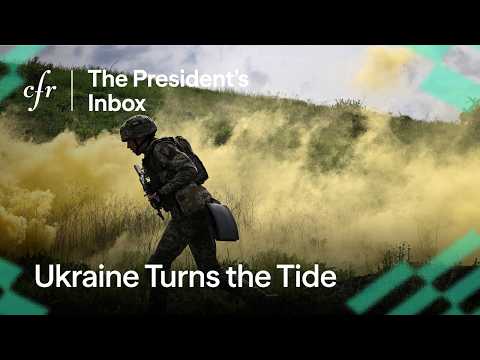
Ukraine Turns the Tide, With Liana Fix | The President’s Inbox

Video thumbnail: Ukraine Turns the Tide, With Liana Fix | The President’s Inbox
Jun 17, 202635m 30s video lengthCouncil on Foreign Relations

The Signal

The war in Ukraine has evolved into a persistent, drone-saturated conflict where Russia’s hopes for a decisive breakthrough or a favorable Trump-mediated settlement have effectively collapsed. While U.S. military aid has stalled, Europe is increasingly institutionalizing support and building industrial autonomy, leaving the central conflict defined by whether Putin’s perceived ideological rigidity or the mounting sustainability of Europe’s defense strategy will dictate the path to a potential ceasefire.

The Case

  • Russia may have failed to secure a durable negotiated exit during the Trump administration, despite reportedly being offered a deal involving limited land swaps that would have allowed the Kremlin to claim real gains.23:47
  • U.S. military assistance to Ukraine has hit a standstill, with no direct aid delivered in 2025 or early 2026, forcing a heavy reliance on intelligence sharing as the primary remaining American contribution.9:52
  • European financial and material support has surged to replace U.S. gaps, with funding for drone co-production jumping from 400 million to 1.6 billion euros since 2022.14:50
  • Analysts, including Liana Fix of the Council on Foreign Relations, suggest that Russia’s primary threat to NATO has shifted from a direct territorial invasion—which Russia currently lacks the personnel to execute—to systematic coercive pressure and political blackmail enabled by perceived U.S. isolationism.19:49
  • The security burden-sharing logic has inverted; European planners now increasingly view Ukrainian resistance as a structural necessity that pins down Russian capacity, rather than an act of European charity.22:18
  • Putin remains hampered by narrow escalation paths, as mass mobilization risks domestic social revolt and existing sabotage and drone operations are already providing diminishing returns.32:53

The 1 Minute Signal Take

This analysis provides a sharp, rigorous assessment of the war’s strategic pivot toward European-led stability, though its claims regarding Putin’s psychological state and the specific terms of failed negotiations remain speculative. Watch it for the granular detail on how Europe is re-engineering its post-U.S. defense reality; you can skip the speculative character analysis of the Russian leadership.

Pro Analysis

Strategic Significance

The war is transitioning from a localized conflict into a definitive test of European sovereignty. The retreat of U.S. military aid forces the EU to demonstrate whether it can transition from a political entity into a hard-power actor capable of managing a hostile neighbor.

Who Should Care

Policymakers, defense industry stakeholders, and global security analysts. The shift from U.S.-centric security to European-managed industrial defense signals a long-term change in transatlantic relations that will outlast the current conflict.

Contrarian Takeaway

The cessation of U.S. military aid might technically increase European stability in the long run. By forcing Europe to develop its own command-and-control and nuclear-contribution plans, the U.S. retreat is creating a more durable, locally incentivized defense architecture that does not rely on the mercurial nature of American electoral cycles.

Time saved:33m 10s

Share this

Tags

Written by: 1 Minute Signal Editorial Team