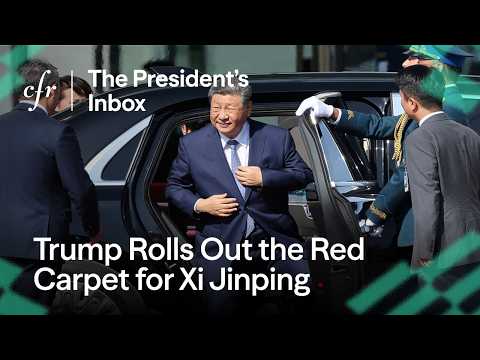
Trump Rolls Out the Red Carpet for Xi | The President’s Inbox

Video thumbnail: Trump Rolls Out the Red Carpet for Xi | The President’s Inbox
Sep 23, 202641m 12s video lengthCouncil on Foreign Relations

The Signal

Xi Jinping is in Washington for his first state visit in a decade, marked by unusually lavish optics including a personal greeting from President Trump at Joint Base Andrews. This high-level engagement aims to stabilize a relationship defined by a tenuous May truce, though observers remain divided on whether this summitry indicates a genuine strategic de-escalation or a tactical concession to Beijing.

The Case

The Optics of Engagement

  • President Trump’s decision to personally greet Xi at Joint Base Andrews is a highly unusual gesture of deference, typically reserved for rare cases like visits from a Pope or the most critical allies.5:33
  • Washington is rolling out a state dinner, military honors, and a flyover, creating a level of high-status treatment that signals a prioritization of bilateral stability over political caution just weeks before the U.S. election.6:06
  • Chinese officials have been anxious to finalize protocol details well in advance, fearing that Trump’s famously unpredictable communication style could result in a public embarrassment.11:52

The Terms of the Truce

  • The visit is intended to flesh out the “constructive relationship of strategic stability” framework established in May, a term Beijing authored and Washington adopted.4:49
  • Critics argue this framework is intentionally vague and currently favors Beijing, which interprets U.S. arms sales to Taiwan as a violation of the stability agreement.16:44

Substantive Flashpoints

  • Taiwan remains the primary red line, with Xi expected to press Trump to delay or deny $14 billion in pending arms sales to Taipei; public polling in Taiwan suggests 47% of citizens already doubt U.S. commitment to their defense.20:27
  • On Iran, China continues to import 90% or more of Iranian oil, yet the U.S. administration appears reluctant to sanction large Chinese banks, seemingly prioritizing the broader China truce over maximizing pressure on Tehran.30:05
  • AI talks are progressing only incrementally; both sides are focused on narrow, practical incident-communication channels, with neither viewing existential AI safety as an urgent priority for breakthrough.23:52

Regional Strategy

  • Xi’s recent travel sequence—prioritizing the Shanghai Cooperation Organization and BRICS summits while continuing to skip the UN General Assembly in person—signals an intent to build influence through non-U.S.-centered institutions.38:17

The 1 Minute Signal Take

The Biden-Trump transition has yielded a policy of high-visibility engagement with China, but the lack of concrete deliverables on Taiwan or Iran suggests the U.S. is trading leverage for a fragile, temporary calm. If this truce is not used to build lasting structural advantages, Washington risks being locked into a Beijing-defined framework that constrains its own regional freedom of action.

Pro Analysis

Why It Matters

This visit marks a pivotal shift toward 'managed competition' where optics serve as a substitute for substantive resolution. By prioritizing the appearance of stability, the administration risks normalizing a power dynamic that favors Beijing's desire for a 'constructive' truce without addressing core threats to U.S. regional interests.

Strategic Implications

The U.S. is effectively trading immediate pressure—specifically regarding Iranian oil financing—for the preservation of a fragile diplomatic channel. This delay tactic is only strategically sound if the time is utilized to harden regional alliances and bolster domestic capabilities; otherwise, it constitutes a slow-motion surrender of leverage.

Evidence & Hype Audit

The content relies heavily on diplomatic signaling and expert interpretation rather than hard data. While the observation of the 'extraordinary optics' is factually grounded in standard diplomatic protocol, the conclusions regarding the efficacy of 'constructive strategic stability' remain highly inferential and speculative.

Counterarguments

One could argue that given the volatility of global markets and the threat of catastrophic escalation in multiple theaters, even a 'Beijing-defined' truce is vastly preferable to an unmanaged breakdown. In this view, buy-time diplomacy is the only rational path.

Role-Specific Takeaways

  • Investors: Monitor for any sanctions-related news concerning Chinese banks; the current 'truce' suggests a high tolerance for status quo but potential for sudden disruption.
  • Policy Analysts: Focus on the $14 billion in pending Taiwan arms sales; their approval or delay will serve as the true barometer for how much the 'constructive strategic stability' framework limits U.S. sovereignty.
  • Corporate Strategists: Note Beijing's growing hostility toward American AI firms (e.g., Anthropic); this is a leading indicator for future market access restrictions.

What to Do Next

  • Verify the status of the $14 billion Taiwan arms package post-visit.
  • Track the frequency and participants of future AI 'incident-management' channels.
  • Monitor Treasury/OFAC for any actions taken against large Chinese banks involving Iranian oil.
  • Assess whether Xi's absence from the UNGA becomes a permanent fixture of Chinese foreign policy.
  • Evaluate local Taiwan opinion polling to see if the perception of U.S. reliability shifts following the summit results.
Time saved:37m 16s

Share this

Tags

Written by: 1 Minute Signal Editorial Team