The Trump Administration Is Taking Big Stakes in Private Companies. Here’s Why.

Video thumbnail: The Trump Administration Is Taking Big Stakes in Private Companies. Here’s Why.
Jul 17, 20261m 55s video lengthCouncil on Foreign Relations

The Signal

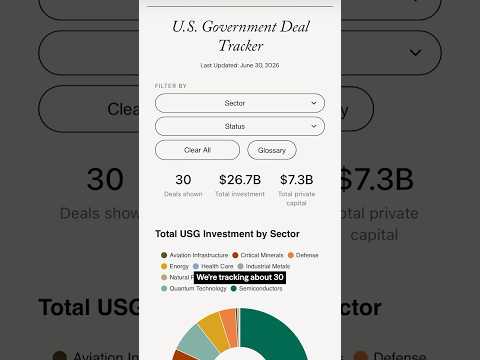
Government intervention in private industry is rapidly expanding through equity and quasi-equity deals that aim to secure strategic sectors against market failure. While authorities have announced roughly 30 deals since early 2025, they are secretly evaluating hundreds more, leaving the actual scale and the defensibility of this public-private entanglement largely unverified.

The Case

The Scale of Intervention

  • Roughly 30 equity or quasi-equity deals have been announced since January 2025, but the Department of War is reportedly evaluating hundreds more, suggesting announced figures represent only a fraction of the total pipeline.0:00
  • The decision to fund these initiatives relies on a two-part mandate: confirming an industry is of strategic importance and demonstrating that a market failure or scarcity of private capital prevents necessary development independently.0:20

The Quantum Justification

  • The Commerce Department highlights nine recent quantum-focused deals as a primary example of this policy, arguing that long development timelines and high uncertainty make the sector unattractive to traditional private investors.0:46
  • The stated justification for these investments is the threat of "QDay," a future point where adversarial quantum computing could break the encryption securing critical infrastructure like smartphones and financial services.1:14

Accountability Gaps

  • The criteria used to judge deal defensibility are proposed by advocates rather than established by neutral standards, and the government has not yet clarified which deals are considered essential versus those that might be less defensible.
  • High-level claims regarding the total volume of deals under review and the inherent difficulty of private quantum funding remain self-reported and lack transparent third-party verification.

The 1 Minute Signal Take

The current approach treats government capital as a necessary floor for long-horizon technology, but the lack of transparent metrics for "defensibility" leaves taxpayers exposed to a massive, unvetted industrial strategy. A reliance on the "strategic" label often serves as a blank check rather than a disciplined tool for addressing specific market shortfalls.

Pro Analysis

Why It Matters

This strategy marks a fundamental drift toward state-led economic steering. By becoming a shareholder in private firms, t...

Full analysis always available on Pro.

Time saved:11s

Share this

Tags