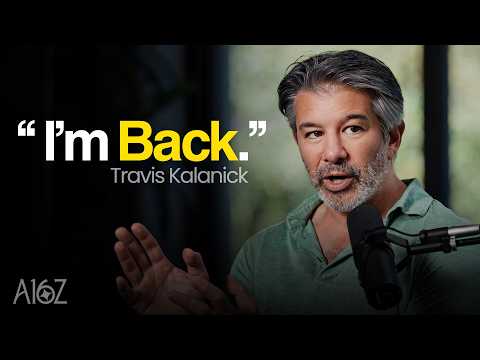
Building a Company in Stealth | Travis Kalanick with a16z

Video thumbnail: Building a Company in Stealth | Travis Kalanick with a16z
Jul 22, 20261h 32m 17s video lengtha16z

The Signal

Travis Kalanick, the founder of Uber, is positioning his post-Uber ventures—Cloud Kitchens, mining autonomy firm Pronto, and logistics—as a singular "atoms-based computer" platform. By applying computational primitives like CPUs and network buses to physical-world manufacturing and transport, he aims to scale industrial automation as rapidly as software once scaled digital services, despite unresolved disputes from his early board history.

The Case

Industrial Thesis

  • Kalanick views global physical infrastructure through a computational lens: manufacturing as the CPU for atoms, real estate as storage, and logistics as the network, aiming to drive meal delivery costs down to grocery-store levels.35:53
  • His current umbrella entity, now structured as a single topco with multiple sub-entities, unites food, mining, and transport in one equity structure to align management across multiple trillion-dollar markets.48:40
  • The mining division, centered on the acquisition of the autonomous mining firm Pronto, frames autonomy as both an existential safety intervention for dangerous sites and a productivity multiplier that can yield "20% more gold per year."43:54

Governance and History

  • The 2011 Uber Series B funding remains a point of contention: Kalanick asserts an auction price fell from $375M to $210M due to interference from Mark Andreessen, while Andreessen’s recollection cites a delegated process and disputes over employee option pools.2:08
  • Kalanick argues that the 2017 crisis at Uber—marked by severe regulatory and reputational damage—taught him that aggressive "pirate" tactics successful in startups become liabilities when a company becomes a dominant "navy," leading him to build his new ventures in stealth to avoid media-driven pressures.18:24
  • He maintains that organizational limits are determined by management capacity rather than ideas, arguing that founder-led, high-alignment structures are more effective than fragmented, acquisition-heavy growth models.52:00

The 1 Minute Signal Take

Kalanick’s framework suggests that the next decade of industrial transformation will be led not by generalized software tools, but by vertically integrated tech-infrastructure companies that treat physical resource movement as a predictable computational problem. Readers should view his claims of operational scale with caution, as his history remains self-reported and his board-level narratives are directly contradicted by his former investors.

Pro Analysis

Why It Matters

This vision represents a pivot from the 'app-layer' digitization of the last decade toward a 'foundational-layer' integration of software and hardware. Kalanick is attempting to control the physical substrate of industries rather than just providing a digital interface for them.

Strategic Implications

Kalanick is betting that vertical integration—owning the real estate, the robotics, and the logistics software—is the only way to squeeze out sufficient margin to make global physical automation profitable. This necessitates a massive capital expenditure model that is fundamentally different from a typical software SaaS firm.

Evidence & Hype Audit

The content relies heavily on Kalanick’s self-reported scale, such as the claim of operations in 30 countries. While his organizational track record is proven, the 'industrial-AI' framework exists as an unproven thesis. He avoids specific financial disclosures in favor of structural and philosophical positioning.

Counterarguments

Critics might argue that Kalanick’s obsession with total control and singular equity structures creates a 'key man' risk that is unsustainable as the company spans 24 time zones. Furthermore, regulators historically resist 'atoms-based' monopolies more aggressively than they do pure-play software.

Who Should Care

  • Logistics Executives: For insights into the shift toward robotic last-mile automation.
  • Industrial Investors: For understanding the merging of real estate and computation.
  • Founders: For a masterclass in using stealth to preserve cultural alignment during the 'building' phase.

What to Do Next

  • Audit existing operational bottlenecks that can be solved with modular robotics.
  • Assess whether organizational culture incentivizes internal correctness over public status.
  • Evaluate if your business model allows for a gradual transition from service-based delivery to infrastructure-based ownership.
Time saved:1h 29m 8s

Share this

Tags

Written by: 1 Minute Signal Editorial Team