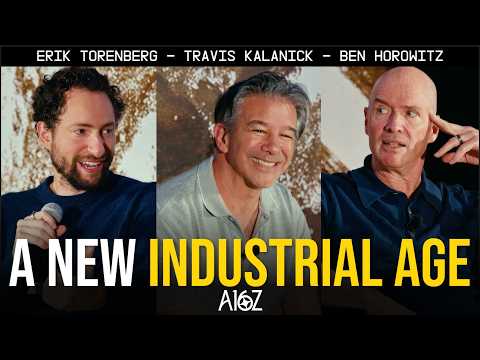
Travis Kalanick on Building Atoms After Uber

Video thumbnail: Travis Kalanick on Building Atoms After Uber
Aug 14, 202654m 51s video lengtha16z

The Signal

Travis Kalanick, the former CEO of Uber, is positioning his current company, Adams, as a successor to his prior work in “digitizing the physical world.” By focusing on industrial AI for food, mining, and transport, he argues that automation can revolutionize sectors that have historically resisted change, while defending his past aggressive management style as a necessity for meritocracy.

The Case

Industrial Automation

  • Kalanick frames Adams as building “industrial atoms-based computers” using software, sensors, and robotics to automate entire physical sectors, moving beyond software-only AI.6:36
  • He targets food delivery at costs near grocery-store pricing, mining operations promising 20% higher annual output, and transport infrastructure as a reusable platform for specialized robots.7:42
  • The company avoids a multi-board structure to maintain operational simplicity across these distinct business units.43:52

Culture and Strategy

  • Kalanick argues that the biggest obstacle to progress is not a single competitor but a general “resistance to change,” drawing historical parallels to conflicts in the steel and energy sectors.14:54
  • He explicitly rebrands the intense, confrontation-heavy “toe-stepping” culture of early Uber as “best idea wins,” framing it as a meritocratic necessity for large-scale operations.25:26
  • He justifies his decision not to acquire Lyft by citing fundamental cultural incompatibility, arguing that the two companies were never a logical fit.22:53

Visibility and Evolution

  • For the past eight years, Kalanick maintained a deliberate “be uniconic” strategy, forbidding thousands of employees from mentioning the company on LinkedIn to avoid public scrutiny.50:54
  • He suggests that shifts in the media landscape—specifically the rise of independent channels—now allow founders to bypass legacy gatekeepers and communicate directly, facilitating his return to the public eye.51:47

The 1 Minute Signal Take

Kalanick is essentially attempting to replicate the Uber playbook—disruptive industrial-scale automation backed by a meritocratic, aggressive culture—while trying to avoid the regulatory and reputational hazards that defined his exit from his previous company. Whether his “industrial AI” thesis delivers or remains purely aspirational depends on his ability to scale complex physical operations without the friction that previously turned his aggressive culture into a liability.

Pro Analysis

Why it Matters

Kalanick’s return to the public sphere signals a shift in the 'founder mode' archetype. By explicitly linking historical ...
Full analysis always available on Pro.

Time saved:52m 58s

Share this

Tags

Written by: 1 Minute Signal Editorial Team