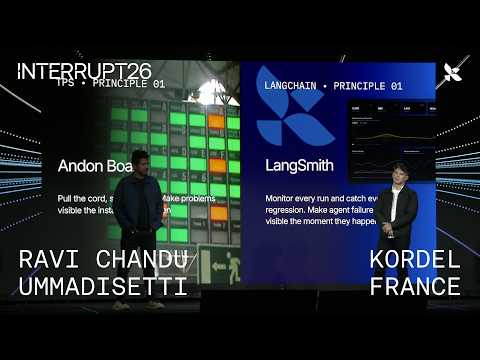
Inside Toyota's Production System for Agents | Interrupt 26

Video thumbnail: Inside Toyota's Production System for Agents | Interrupt 26
Jul 15, 202616m 31s video lengthLangChain

The Signal

Toyota’s enterprise AI team built an internal platform, ToyotaGPT, to consolidate fragmented, duplicated, and unstandardized agent development. By unifying ingestion and automating graph construction via LangGraph, Toyota claims to have collapsed agent production time from months to days, creating a production-floor-to-R&D system that relies on central governance over local bespoke implementation.

The Case

The Mechanism

  • Toyota engineers claim they standardized deployment by building dynamic graph creation in LangGraph, allowing them to auto-generate workflows based on specific use cases and data connectors.2:09
  • The team asserts that because the platform architecture—including security and indexing—is centralized and immutable, new AI agents require no individual security or architecture reviews, potentially accelerating delivery from six engineers and six months to a single engineer in four days.1:40
  • To manage heterogeneous data including scanned manuals from the 1990s, CAD files, and multilingual tables, Toyota built a unified extraction layer that feeds everything into one searchable index, bypassing external enterprise license costs.2:50

The Industrial Analogy

  • Kordel, the head of AI engineering at Toyota, frames his company's adoption of the LangChain ecosystem as a modern technological iteration of the Toyota Production System (TPS).10:14
  • He maps specific platform features to industrial management concepts: LangSmith tracing functions as an 'Andon' board for real-time root-cause inspection, while LangGraph represents 'Jidoka' by automating repetitive graph assembly while keeping engineers in the loop.11:01

Production Scale

  • Toyota reports over 50 agents currently in production, including GearPull, which resolves manufacturing line downtime by retrieving diagnostics in 10 seconds rather than requiring manual lookups in physical manuals.5:39
  • While the team frames these platform improvements as a total transformation of their enterprise capabilities, quantitative evidence regarding long-term cost savings and the true extent of the claimed 'zero review' governance remains internally asserted rather than independently documented.5:06

The 1 Minute Signal Take

Toyota’s platform strategy highlights that for large enterprises, AI scaling is less about the sophistication of the model itself and more about solving the massive, repetitive plumbing bottleneck of data extraction and workflow governance. Readers should view the performance metrics as a product-story case study, as the systemic impact of these agent 'factories' is still in its early stages of institutional adoption.

Pro Analysis

Why It Matters

Toyota's approach demonstrates the transition of GenAI from experimental 'toy' applications to foundational enterprise infrastructure. Instead of treating agents as standalone projects, Toyota is treating them as products on a factory line, which is the necessary next step for large-scale industrial adoption.

Strategic Implications

By tying agent deployment to configuration-managed graphs, Toyota centralizes its security and governance surface. This reduces the 'shadow AI' risk that plagues many large enterprises, as engineers are incentivized to build with the platform rather than around it.

Evidence & Hype Audit

This content is a high-level self-report. While the examples (GearPull, R&D GPT) are compelling, the specific metrics (six months to four days) are likely 'best-case' outcomes. The assertion that LangChain is the 'future bedrock of all SaaS' is clearly marketing-influenced hyperbole rather than an architectural inevitability.

Counterarguments

The 'no security review' claim is concerning. In a highly regulated environment like automotive manufacturing, claiming a total absence of review suggests either extreme faith in the underlying template or an underestimation of compliance depth. Standardizing too aggressively can also create 'system brittleness' where if the core platform breaks, 50+ dependent agents go down simultaneously.

What to do next

  • Audit your organization for duplicate AI ingestion pipelines and centralize them now.
  • Adopt observable orchestration frameworks like LangGraph to identify failure modes before they reach end users.
  • Build your 'extraction layer' as a distinct, reusable foundation before focusing on agent logic.
  • Define your 'skills' library as modular components rather than monolithic agent code.
Time saved:13m 21s

Share this

Tags