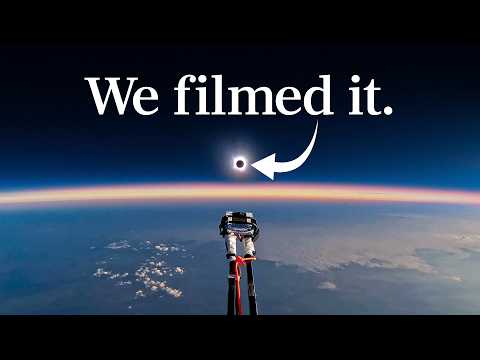
Total Solar Eclipse From Space

Video thumbnail: Total Solar Eclipse From Space
Aug 17, 202622m 45s video lengthVeritasium

The Signal

Total solar eclipses are rare events that act as unique scientific windows, historically enabling the discovery of helium and the identification of ionized iron. While our understanding of orbital geometry explains why eclipses occur in patterned seasons, the specific cause of atmospheric shadow bands remains an open question that resists settled explanation.

The Case

Orbital Mechanics and Frequency

  • Solar eclipses occur within ~34-day 'eclipse seasons' dictated by the Moon’s 5° orbital tilt, which creates two nodes where the Moon can intersect the Earth-Sun plane.3:52
  • Recurrence is patterned rather than uniformly rare; mapping from 2000 BCE to 3000 CE shows the Northern Hemisphere experiences approximately 15% more total eclipses due to orbital eccentricity, though this asymmetry reverses every 9500 years.2:00
  • Every solar eclipse is geometrically paired with a lunar eclipse occurring roughly two weeks before or after, ensuring lunar visibility when the orbital alignment is inverted.5:46

Scientific Observations

  • NASA-funded teams utilized the 2026 Spain event to launch balloon payloads to the edge of space, while a separate jet mission chased the Moon’s shadow at 460 mph to gain a longer, more stable viewing window for sensitive solar instruments.9:27
  • Historical eclipse spectroscopy allowed astronomers like Jules Janssen and Norman Lockyer to identify helium in 1868; later, the 'coronium' line observed in the corona was eventually proven to be iron stripped of 13 electrons.10:17
  • Shadow bands—faint, undulating light patterns appearing seconds before totality—were observed during the event, yet the transcript explicitly categorizes their cause as an unresolved mystery involving potential atmospheric refraction and lighting effects.15:10

Visual Phenomena

  • The Sun appears white during totality because it is bright enough to view directly, whereas common yellow or orange hues in eclipse footage are artifacts of the photography filters used to protect cameras during partial phases.6:21
  • Pinhole projections—such as light passing through tree leaves or small apertures—demonstrate how straight-line light travel and inversion turn the Sun’s image into crescents on the ground during an eclipse.11:06

The 1 Minute Signal Take

Eclipses serve as a vital, if fleeting, laboratory for solar physics, but the persistent ambiguity surrounding shadow bands underscores that even highly predictable celestial mechanics can host unresolved physical phenomena. Viewers should distinguish between the well-mapped geometry of eclipse seasons and the ongoing, speculative research into ground-level atmospheric effects.

Pro Analysis

Why It Matters

Total solar eclipses serve as rare, high-stakes observational windows into the Sun's outer atmosphere. Beyond their cultural impact, they allow scientists to test instruments under unique lighting conditions, advancing our understanding of stellar physics that would otherwise remain hidden in the sun's glare.

Strategic Implications

For research institutions, the video highlights the necessity of multi-platform observation strategies. Relying solely on ground-based sites is susceptible to weather and atmospheric turbulence; deploying balloons and jets provides the redundancy and altitude necessary to collect high-fidelity data that informs our broader model of solar activity.

Evidence & Hype Audit

This content is highly trustworthy, relying on established astronomical principles and historical scientific accounts. The narrator maintains intellectual humility, explicitly flagging 'shadow bands' as an open scientific mystery rather than forcing a definitive, potentially incorrect explanation. The 80,000 Hours sponsorship is clearly delineated as promotional and does not interfere with the scientific narrative.

Counterarguments

Critics of the 'modeled patterns' of eclipse frequency might argue that our long-term datasets (spanning 5,000 to 10,000 years) are prone to simulation errors. While the geometry is sound, the specific claim of a 15% Northern Hemisphere advantage depends on the precision of the underlying orbital model used for mapping.

Who Should Care

  • Educators: Use the pinhole projection and seasonal geometry to teach foundational optics and orbital mechanics.
  • Astronomers/Physicists: Note the platform stability tradeoffs between balloons and jets for future sensor deployments.
  • Casual Observers: Understand the 'color change' as a lens artifact to better appreciate the actual visual experience of totality.

What To Do Next

  • Verify the current eclipse season status to understand when the next opportunity for similar observations will occur.
  • Research historical 'coronium' papers to study how erroneous elements were corrected via spectroscopy.
  • Compare ground-based versus jet-based solar instrument stability parameters for future mission planning.
  • Investigate the physics of atmospheric refraction to see if recent models offer a definitive explanation for shadow bands.
Time saved:19m 8s

Share this

Tags

Written by: 1 Minute Signal Editorial Team