The Phone Number puzzle

Video thumbnail: The Phone Number puzzle
Sep 25, 202644s video length3Blue1Brown

The Signal

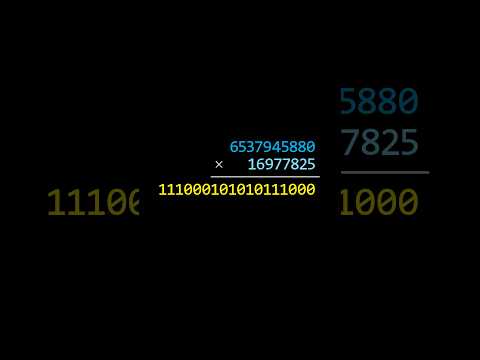
A mathematical puzzle asserts that for any phone number, a multiplier exists that results in a product composed only of 0s and 1s. This claim includes a stronger special case for numbers ending in 1, 3, 7, or 9, where the product can consist entirely of 1s. While the theorem is established as a proof task, the underlying mechanism and constructive proof are not provided, leaving the core logic to the listener.

The Case

The Mathematical Theorem

  • Any phone number can be multiplied by some positive integer to create a larger number containing only the digits 0 and 1.0:01
  • A stricter condition holds if the number ends in 1, 3, 7, or 9: the resulting product can be made of 1s alone.
  • These claims are presented as a monthly proof challenge; the transcript defines them as factual properties of numbers rather than subjects of debate.

Computational Implementation

  • The narrator claims that a naive brute-force search for such a multiplier is almost certainly too computationally expensive for standard resources.0:27
  • A smarter search strategy is said to exist, as the underlying proof logic supposedly provides a path to identifying the multiplier efficiently.
  • The transcript omits both the proof and the construction of this smarter search algorithm, characterizing them as the puzzle to be solved.

The 1 Minute Signal Take

This is a classic number theory challenge framed as a computational hurdle. If you are looking for the solution, focus on the structural properties of numbers ending in 1, 3, 7, or 9 rather than brute-force iteration.

Pro Analysis

Why It Matters

This puzzle serves as a quintessential example of how theoretical mathematics provides the 'shortcuts' necessary for real...
Full analysis always available on Pro.

Share this

Tags

Written by: 1 Minute Signal Editorial Team