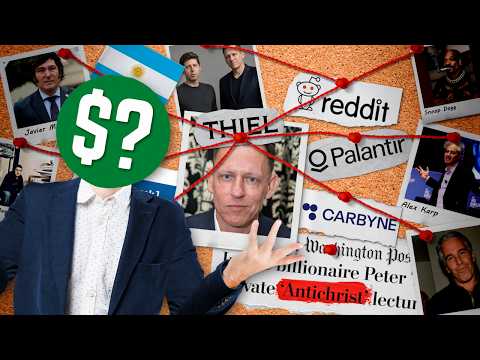
WTF Does Peter Thiel Actually Do?

Video thumbnail: WTF Does Peter Thiel Actually Do?
Jul 27, 202621m 6s video lengthHow Money Works

The Signal

Peter Thiel has transitioned from a traditional venture capitalist into an ideologically driven force using deep-pocketed investments to reshape political, social, and technological systems. While he avoids consumer-facing vulnerability through extreme diversification, his recent, increasingly erratic public behavior raises questions about whether this visibility serves as strategic signaling for a new, contrarian regime of founders.

The Case

Wealth and Influence

  • Thiel, who moved his primary residency to Argentina roughly 10 months ago to avoid California wealth-tax proposals, holds multiple citizenships including Germany, the U.S., and New Zealand to insulate his assets from localized regulatory or civilizational disruption.18:56
  • His personal Roth IRA, which started with a $1,700 contribution in 1999, surged to roughly $5 billion through early-stage bets on companies like Palantir and Facebook, illustrating both his extraordinary performance and the power of tax-sheltered wealth.11:18
  • He has weaponized his capital to punish critics, most notably by personally financing the lawsuits that led to Gawker's 2016 bankruptcy after the media outlet outed him as gay in 2008.16:18

Strategic Ideology

  • While his early career followed standard exit-seeking patterns, his current portfolio—including the $525M-plus Praxis project for an internet-native nation—suggests a shift toward worldview-shaping where traditional investor ROI is often secondary to libertarian or anti-regulatory goals.13:21
  • He spent $15 million supporting J.D. Vance in 2022, utilizing the Protect Ohio Values super PAC to allegedly route voter data through an obscure blog to circumvent campaign finance guidelines.15:27
  • Palantir, the data-analytics firm he co-founded, acts as a primary institutional anchor, receiving $687 million from the U.S. government in the first quarter of this year alone despite Thiel’s ongoing, contentious relationship with mainstream media and regulatory bodies.16:56

The 1 Minute Signal Take

Thiel's career shift from standard wealth compounding to radical, state-facing influence suggests he operates as a private systemic player rather than a market participant. His moves—spanning political donations, citizenship diversification, and niche tech ventures—indicate a calculated preparation for institutional instability, rendering his public provocations more likely to be purposeful branding than self-sabotage.

Pro Analysis

The Power Disparity

Thiel represents a new class of billionaire whose influence is not confined to the boardroom. By weaving together political lobbying, judicial intervention (Gawker), and the actual construction of 'network states,' he is effectively engaging in a form of private governance.

Strategic Implications

His move to Argentina, coupled with his heavy backing of nationalist-libertarian figures, suggests a move toward geographic arbitrage. He is de-risking his personal security while his empire remains deeply embedded within U.S. government operations. This is a masterful, if cynical, split between personal autonomy and political utility.

Hype Audit

The content relies heavily on circumstantial correlations—linking his 'weirdness' to his business strategy—without an explicit cause-and-effect dataset. While the financial facts regarding Palantir and Clarium are well-documented, the 'doomsday bunker' narrative and the 'fascist' labels are speculative and carry significant editorial weight that may lack neutral verification.

Counterarguments

One could argue that Thiel’s actions are simply 'high-conviction' rationalism. In a world of safe, incremental tech upgrades, his focus on hard-tech (nuclear, manufacturing) is not 'ideological' but a necessary correction to a stagnant capital market.

Role-Specific Takeaways

  • For Founders: Understand that taking money from Thiel involves an implicit alignment with his broader political and industrial network.
  • For Policymakers: Recognize the danger of state reliance on private, ideological, and opaque data brokers like Palantir.
  • For Journalists: Thiel’s 'Objection' platform suggests a future where media claims are challenged by adversarial, AI-driven scrutiny rather than traditional editorial processes.

Next Steps

  • Map the overlaps between his 'Frontier' funds and current national security legislation.
  • Investigate the governance structures of 'tech cities' in the Thiel portfolio to see how they resolve local disputes.
  • Research the impact of the 'Gawker precedent' on current investigative media funding.
  • Track the movement of tech-industry voter data through 'obscure blogs' as a standard PAC operational tactic.
Time saved:17m 51s

Share this

Tags

Written by: 1 Minute Signal Editorial Team