
- Ancient populations retained a latent, shared biological and cultural toolkit despite tens of thousands of years of geographic divergence.
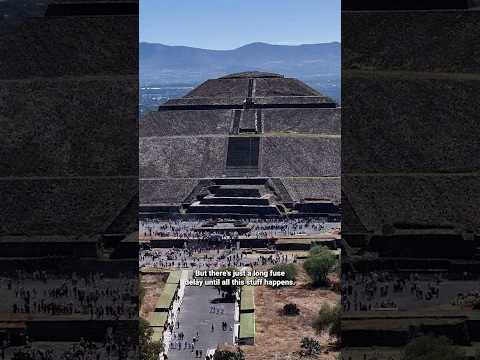
- The manifestation of monumental achievements at Teotihuacan suggests a long delay between the acquisition of human capability and its visible expression.
- The site effectively dispels 'old world superiority' by demonstrating complex construction feats entirely outside traditional Eurocentric technological frameworks.
Channel: Dwarkesh Patel
They Built This Without Wheels or Metal - David Reich
The archaeological site of Teotihuacan in Mexico serves as a powerful testament to human engineering capacity, challenging traditional assumptions about technological progress and ancient history.
Key Takeaways
- Teotihuacan stands as an extraordinary architectural achievement on par with the scale and impressiveness of ancient Egypt.
- The site represents a massive engineering feat accomplished entirely without the use of metal tools, draft animals, or wheels.
- Exposure to these monumental remains acts as a corrective for observers harboring notions of old world superiority.
Talking Points
Analysis
Strategic Significance
Teotihuacan challenges the assumption that technological complexity is the primary metric of human achievement. It highlights that organizational and cultural synchronization can produce results comparable to civilizations with vastly different toolsets.
Who Should Care
Historians, behavioral scientists, and engineers should pay attention. Those who study human cognition or the origins of civilization benefit from considering how complex logistics were managed without traditional mechanical infrastructure.
Contrarian Takeaway
The 'old world' may not have been the repository of all early ingenuity; geographical isolation often acts as a laboratory for complex human problem-solving that is fundamentally equal to, rather than derivative of, continental peers.
Channel: Dwarkesh Patel