
Channel: Sandeep Swadia | theMITmonk
How To Think SO CLEARLY People Assume You're A Genius
The Signal
Systems thinking is presented as a diagnostic meta-skill for distinguishing how to approach a challenge: clear problems (checklists), complicated ones (expert analysis), complex ones (experimentation), or chaotic ones (immediate stabilization). The central tension is that while these classifications provide an operational roadmap, they are heuristics that often oversimplify reality, demanding that you use mentors, data, and time to prevent becoming blinded by your own internal perspective.
The Case
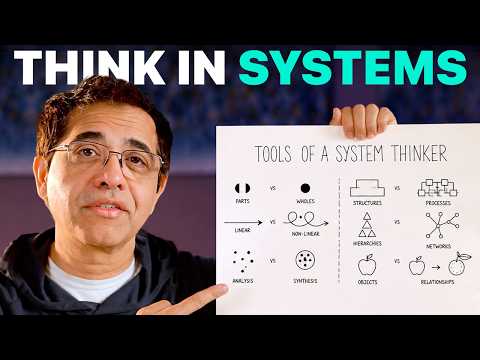
- Systems thinking is defined by mapping hidden parts, their connections, and repeating patterns within a domain like a marriage, business, or career.
- The "Dart" framework is the proposed diagnostic tool: Deconstruct the problem, Analyze the system type, Recognize recurring patterns, and Test interventions before committing.
- Clear systems, such as surgical scrubs or pilot protocols, are best navigated with checklists, whereas complicated problems like financial planning require domain-specific experts who can discover hidden cause-and-effect paths.
- Complex systems, illustrated by an acquisition where cultural mismatch caused leadership to flee within 90 days, require small, adaptive experiments because outcomes are only visible in hindsight.
- Chaotic systems require immediate stabilization rather than analysis; the narrator cites Johnson & Johnson’s decision to pull 31 million Tylenol bottles after seven deaths as the definitive case study in acting before understanding.
- The cobra effect—where a government bounty on snakes led citizens to breed them—serves as a primary warning on how perverse incentives can invert the desired outcome of a system.
- The narrator claims personal identity is a system one can redesign, using his own history of running from his father toward monk training as an example of how honest external feedback clarifies one's true trajectory.
The 1 Minute Signal Take
This is a robust framework for categorizing problems, though the narrative drifts into overconfident territory when asserting universal truths about AI or business binaries like the "Ferrari vs. Toyota" dilemma. Watch this if you want a clear mental taxonomy for operational problems, but skip it if you are looking for evidence-based research rather than curated anecdotes.
Time saved:
Channel: Sandeep Swadia | theMITmonk