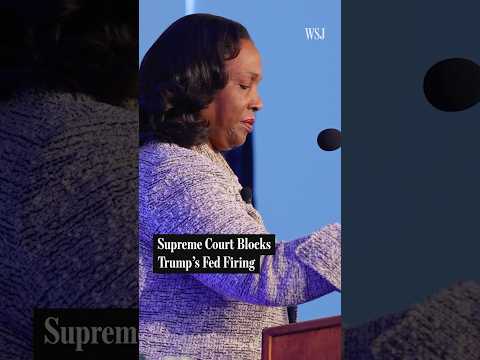
What the Supreme Court’s Ruling Over Lisa Cook Means for the Fed

Video thumbnail: What the Supreme Court’s Ruling Over Lisa Cook Means for the Fed
Jun 29, 20261m 58s video lengthThe Wall Street Journal

The Signal

The Supreme Court has temporarily blocked the removal of Federal Reserve Governor Lisa Cook, ensuring she remains in her position at least for now. Chief Justice John Roberts framed the dispute as a structural test of central-bank independence, questioning whether governors can be dismissed at will by a president without a fair opportunity to contest the allegations of misconduct. While the Court reinforced procedural guardrails, the underlying merits—specifically the Trump administration’s claim that Cook misrepresented mortgage applications five years ago—remain unsettled and have been remanded to a lower court for further review.

The Case

  • Supreme Court justices ruled that Lisa Cook, a member of the Federal Reserve Board of Governors, cannot be immediately removed, effectively stalling the administration’s effort until deeper legal proceedings take place.0:00
  • The Trump administration justified its move for removal by alleging that Cook misrepresented mortgage applications five years ago, a claim the transcript presents purely as an assertion without independent evidence.0:22
  • Chief Justice John Roberts prioritized the precedent of institution-level independence, arguing that if governors cannot challenge a removal decision, the position becomes effectively subservient to the president’s will.0:50
  • The decision was sent back to a lower court for a formal review of the underlying facts, meaning Cook’s long-term job security is not yet guaranteed and the truth of the mortgage allegations remains legally contested.
  • Analysts mentioned in the report suggest the decision indirectly bolsters the position of Kevin Worsh, the new Fed chairman selected in January, by providing the board with firmer legal protection against administrative interference.1:11

The 1 Minute Signal Take

This update is a procedural holding pattern rather than a final ruling, effectively preserving the status quo while the judiciary scrutinizes the executive branch’s power to enforce “for cause” removal. The logic hinges entirely on whether you believe the Court’s role is to verify the administration’s specific allegations against Cook or merely to ensure it follows the correct legal process for removing a protected public official. Watch the video if you want the specific tone and characterization of the Supreme Court's debate, but otherwise, this summary covers the essential legal and institutional stakes.

Pro Analysis

Strategic Significance:

  • The ruling establishes a major precedent for administrative law, asserting that the Supreme Court will not allow 'independent' agency heads to be converted into at-will political appointees through procedurally opaque removal processes.

Who Should Care:

  • Institutional investors and fixed-income traders must care, as the autonomy of the Fed is the foundation of long-term inflation forecasting and market stability.

Contrarian Takeaway:

  • While the ruling is framed as a defense of the Federal Reserve, it might actually signal a future where the Court expects the Fed to be more transparent and legally accountable in its internal affairs, potentially opening new avenues for future legal challenges against its members.

Share this

Tags